How to Position a Tractor on an Equipment Trailer
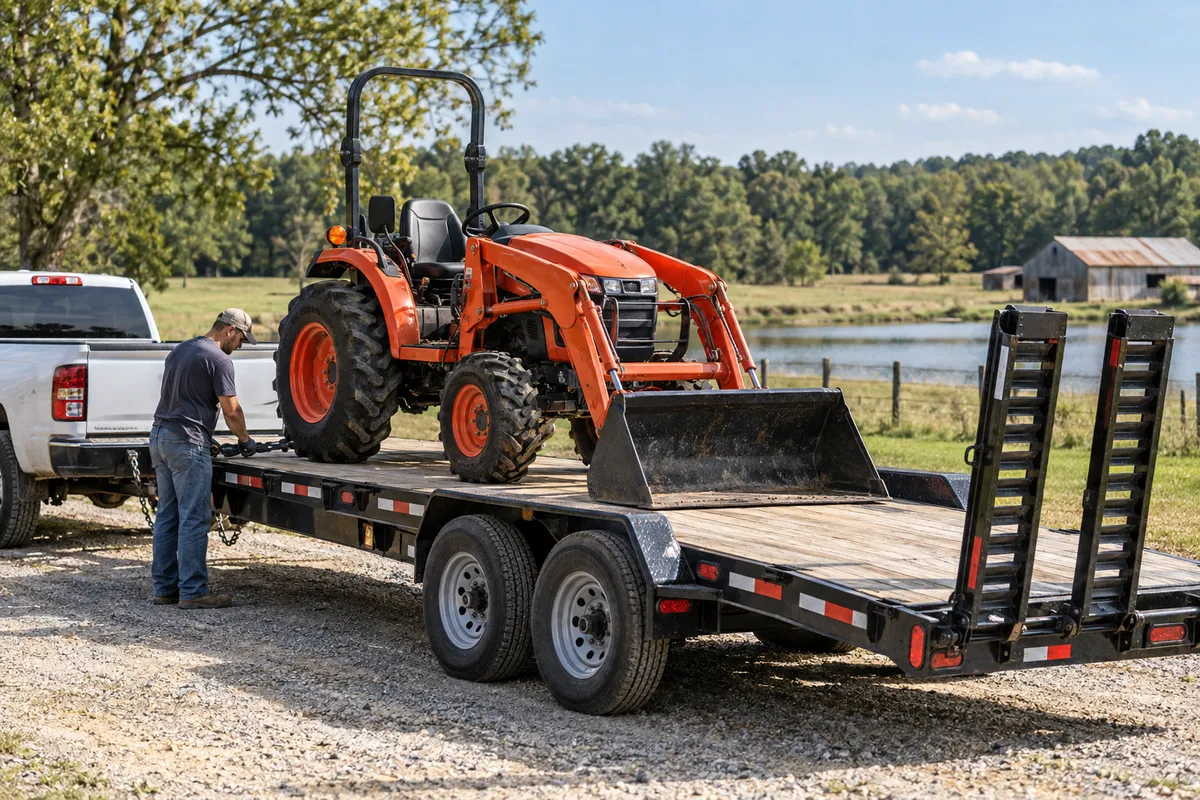
Where exactly should a tractor sit on the trailer? Far enough forward that about 60 percent of its weight is ahead of the axles. On most equipment trailers, that means the front axle of the tractor lands somewhere around the middle of the deck.
Here is how to get it right.
Find the balance point first
Before you drive anything on, locate the trailer’s axle centerline.
On a single-axle trailer, that is the axle itself. On a tandem-axle trailer, it is the midpoint between the two axles.
Mark it. A piece of tape on the rub rail works. Now you have a visible reference instead of guessing.
Point the heavy end forward
On almost every tractor, the heavy end is the front. The engine sits up there, and if there is a loader mounted, that adds another 700 to 1,200 lbs to the nose.
So most tractors load nose first, driving forward up the deck.
The exception is a tractor with no loader but a heavy rear implement, like a big box blade or a bush hog. If the back is genuinely heavier, backing on may balance better. That is uncommon but worth thinking about rather than assuming.
Aim the front axle near the deck midpoint
Here is a practical starting point that gets most compact tractors close.
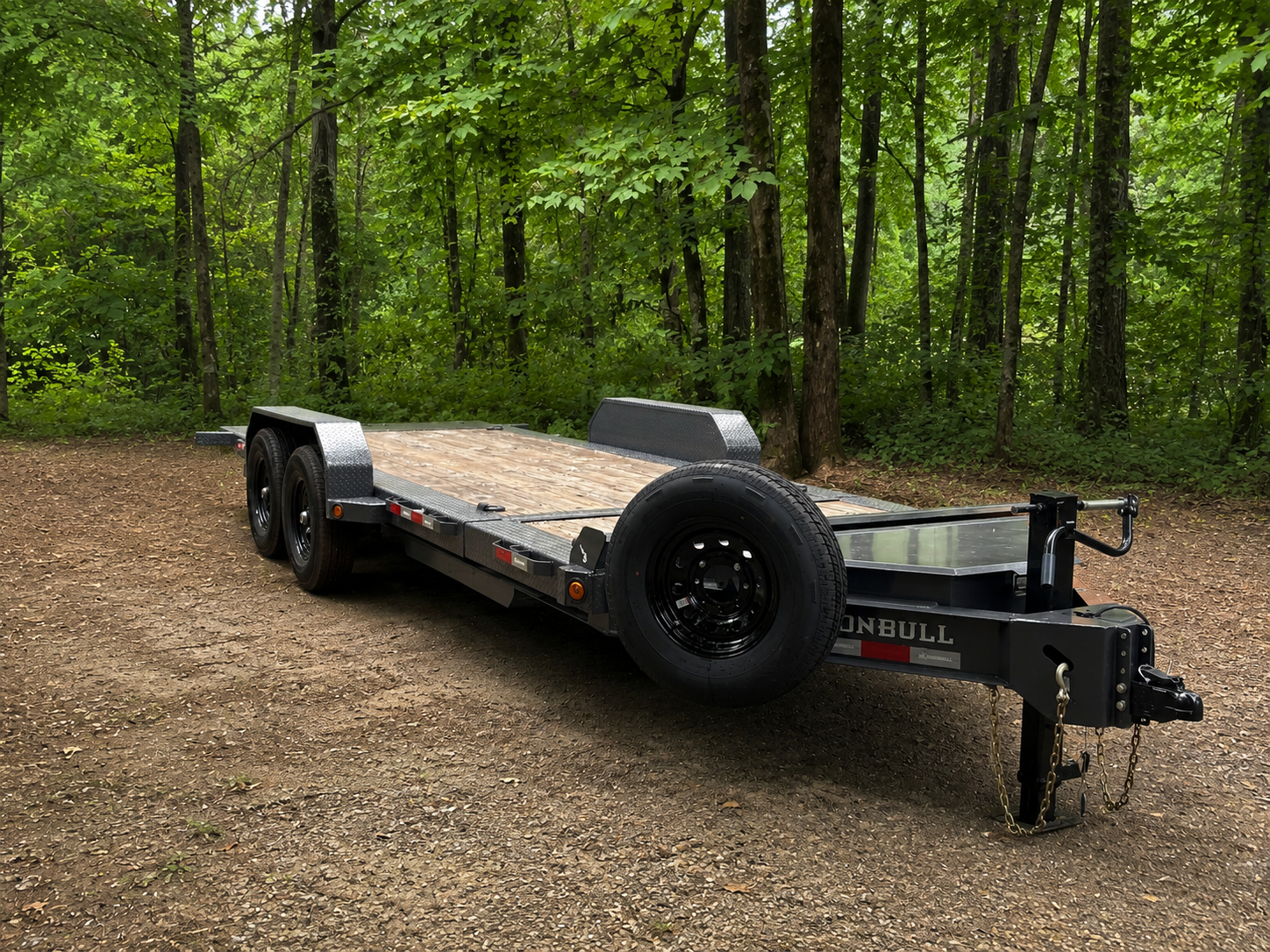
Drive on until the tractor’s front axle is roughly at the midpoint of the deck length. On our 20-ft tilt deck, that puts the front axle around 10 feet back from the front of the deck.
With a typical compact tractor, that places most of the machine’s mass forward of the trailer axles, which sit farther back.
Then check your work rather than trusting the rule of thumb.
How to check without a scale
Look at the truck. Some rear squat is normal. If the back drops hard and the front visibly rises, you are too far forward and tongue weight is too high.
Look at the trailer. It should sit roughly level once hooked up. Nose-high means the load is too far back. Nose-low means too far forward.
Measure the fender gap. Before hooking up, measure from the ground to your truck’s rear fender lip. Measure again with the loaded trailer attached. One to two inches of drop is normal for a properly loaded setup. Three or more says too much tongue weight.
Tongue weight should be 10 to 15 percent of the loaded trailer weight. Our post on tongue weight covers the details.
Adjust in small increments
If you need to change it, move the tractor a foot at a time.
Small moves matter more than people expect. On a 20-foot deck, sliding a 5,000 lb tractor forward one foot shifts a meaningful amount of weight onto the tongue.
Do not jump from one end of the deck to the other and hope.
Lower everything before you check
This changes the balance, so do it before you evaluate the position.
Lower the loader bucket flat onto the deck. Lower any three-point implement to the deck.
A lowered bucket does three things. It drops the center of gravity. It puts some front weight directly onto the deck instead of onto the tractor’s tires and suspension, which reduces bounce. And it stops the loader from moving in transit as hydraulics bleed down.
If the bucket cannot reach the deck because of where the tractor sits, that is a sign to reposition.
Center it side to side
Front-to-back gets all the attention, but left-to-right matters too.
A tractor sitting off-center puts more weight on one set of tires and springs. The trailer leans, one tire wears harder, and it gets worse in turns.
Line the tractor up with the center of the deck as you drive on. If you notice it is off after the fact, it is worth backing off and redoing rather than living with it.
Watch your width and overhang
Most compact tractors run 48 to 72 inches at the rear tires, but the loader bucket can be wider. Our tilt deck is 6’ 11" wide. Measure the widest point of your machine, not the spec sheet tread width.
Alabama caps trailer width at 8 feet on most roads.
For length, if an implement extends past the back of the deck, you need a flag on it. Better to reposition so it does not overhang if you have the deck length.
Then secure it
Position is only half the job. Four chains, one at each corner, angled outward and downward at roughly 45 degrees, connected to real tie-down points on the tractor and real anchor points on the trailer.
An implement on the three-point usually needs its own separate chain, because the three-point hitch has hydraulic give in it and lets the implement bounce.
Our post on tying down a compact tractor walks through it.
Judge the first mile
A correctly positioned tractor makes the whole combination feel boring. Steady, planted, no drama.
If you feel side-to-side wander at 45 mph, pull over safely and move the tractor forward. Do not wait to see whether it settles down at highway speed. It will get worse, not better.
Then recheck your chains after five or ten minutes, because the tractor will have settled slightly and tension drops.
Questions about positioning a specific machine? Get in touch.
Serving Montevallo, Alabaster, Pelham, Calera, Helena, and the south Birmingham metro.