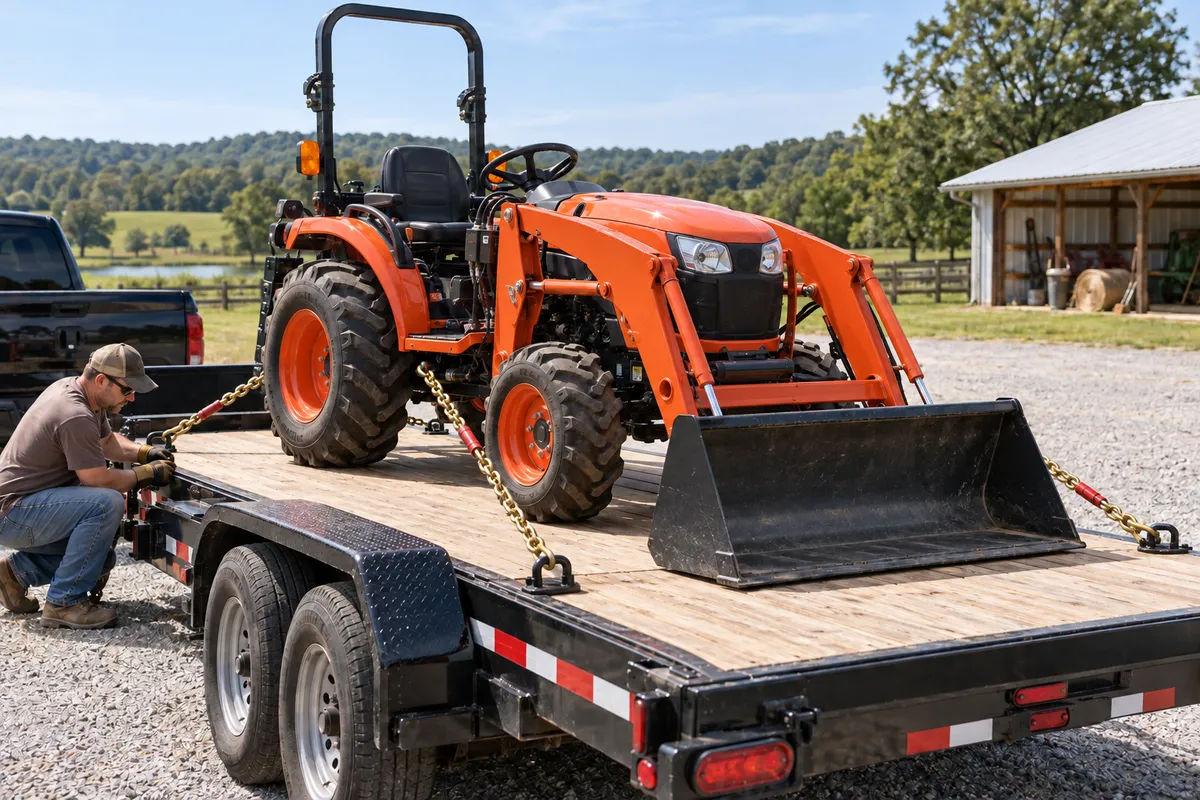
How to Tie Down a Compact Tractor for Transport
How many chains does a compact tractor need? Four, at minimum, one at each corner. And if there is an implement on the three-point hitch, it usually needs its own separate securement.
Here is how to do it properly.
Before you tie anything down
Get the tractor positioned first. About 60 percent of its weight should sit ahead of the trailer’s axles, which for most tractors means driving on nose first since the engine and loader are up front.
Then settle the machine:
- Lower the loader bucket flat onto the deck
- Lower any three-point implement to the deck
- Put the transmission in park, or in gear on a manual
- Set the parking brake
- Shut it off and take the key
Lowering the bucket does more than you might think. It drops the center of gravity, takes bounce out of the ride, and puts some of the front weight directly on the deck instead of on the tires and suspension.
Use chains, not straps
For a compact tractor, use chains and binders.
Ratchet straps are fine for mowers, ATVs, and cars. A tractor is different. It is heavy, it has sharp cast and steel edges that cut webbing, and it often has grease and hydraulic fluid on it. Chain does not stretch, does not cut, and does not care about oil.
Grade 70 transport chain is the standard for this. It is usually gold or yellow-tinted and stamped with a “7” or “70” on the links.
Find the right attachment points
On the tractor, use points the manufacturer intended for tie-downs. Most compact tractors have marked tie-down loops or lugs, often on the frame near the front axle and on the rear axle housing or drawbar area.
What not to use:
- The loader arms or bucket. They move, and hydraulics can bleed down.
- The three-point arms. Same problem. They are designed to move.
- The steering linkage or any hydraulic line. Obvious, but it happens.
- The ROPS bar. It is built to protect the operator in a rollover, not to be tensioned against.
If you cannot find four solid points, check the operator’s manual. It usually shows them.
On the trailer, use the built-in D-rings, stake pockets, or rub rail. Not a fender, not a light bracket, not a ramp.
The four-point pattern
Run one chain from each corner of the tractor, angled outward and downward toward the trailer.
Front chains pull forward and out. Rear chains pull backward and out. That pattern resists the tractor sliding forward under braking, sliding back under acceleration, and shifting sideways in a turn.
Braking is where most loads move, and braking throws the load forward hard. Two chains straight down do very little against that.
Aim for roughly 45 degrees on each chain. A chain running nearly straight down holds the tractor against the deck but does not stop it sliding. A chain running nearly flat pulls sideways but does not press it down. Around 45 degrees does both.
You will not hit exactly 45 every time. Just avoid the extremes.
Check your working load limit
Every chain and binder has a working load limit, or WLL. That is the most it should carry. It is stamped on the chain hook or the binder.
Do not use breaking strength. That is the failure point, and it is typically three times the WLL.
Add up the WLL of all four chains. The total should be at least half the weight of the tractor. A 5,000 lb tractor needs chains adding up to at least 2,500 lbs of working load limit.
Tension in a pattern
Snug all four chains first. Do not fully tighten one before touching the others.
Then go around a second time and bring each to full tension. Working in a pattern keeps the tractor centered rather than pulling it toward whichever corner you tightened first.
You want the tractor’s suspension and tires to compress slightly. Firm, not crushed. Overtightening can bend a tie-down point or damage the binder.
Secure any loose chain so nothing hangs near a tire or drags.
Attachments usually need their own chains
A box blade or bush hog on the three-point is often best secured separately, with its own chain to the deck.
Here is why. The three-point hitch is a hydraulic system with some give in it. An implement bouncing on the three-point puts repeated shock loads into the tractor’s tie-downs and can work them loose.
A separate chain from the implement directly to the trailer takes that movement out of the equation.
Also remember: attachments count toward your total weight. A loader adds 700 to 1,200 lbs, a box blade 300 to 700 lbs, and fluid-filled tires 400 to 800 lbs. Our post on trailer payload capacity covers the math.
Recheck after a few miles
This is the step that matters most.
Pull over somewhere safe after five or ten minutes and check every chain. Loads settle. Tires compress. The tractor shifts a fraction of an inch into place, and chains that were tight in the driveway are now looser.
Retension anything that has gone slack. Check again at your next stop, and roughly every hour on a longer haul.
Our 20-ft tilt deck equipment trailer has the deck length to position a compact tractor properly and the tie-down points to secure it. Questions about your specific machine? Get in touch.
Serving Montevallo, Alabaster, Pelham, Calera, Helena, and the south Birmingham metro.
