How to Secure a Load on a Trailer
How tight is tight enough? That is the question almost every first-time renter asks, and it is the wrong one to start with. Securing a load is less about brute force and more about angles, ratings, and anchor points. Get those right and the tension takes care of itself.
Here is how to do it.
Start with the anchor points
Before you touch a strap, find where it will connect on both ends.
On the trailer, use the built-in D-rings, stake pockets, or rub rails. These are engineered to take load. Do not hook to a fender, a light bracket, a ramp, or a random piece of frame that looks sturdy.
On the load, find a point the manufacturer intended for tie-downs. Most equipment has marked tie-down loops. On a vehicle, use the frame or the designated points, not a suspension arm, a bumper, or an axle. Suspension parts move, and a strap that was tight when you loaded it goes slack as soon as the suspension settles.
If you cannot find four solid points, stop and rethink the load before you go any further.
Use four points, not two
Two straps hold a load down. Four straps hold it in place.
Run one from each corner, angled outward and downward. Front straps pull forward and out. Rear straps pull backward and out. That pattern stops the load from sliding forward under braking, sliding back under acceleration, and shifting side to side in a turn.
Two straps straight down do almost nothing against sliding. Braking is where most loads shift, and braking pushes the load forward hard.
Aim for a 45-degree angle
The angle of the strap does the work.
A strap that runs almost straight down holds the load against the deck but does little to stop it from sliding. A strap that runs almost flat pulls sideways but does not press the load down.
About 45 degrees splits the difference. It presses down and pulls back at the same time. You will not hit exactly 45 degrees every time, and that is fine. Just avoid the extremes.
Know your working load limit
Every strap and chain has two numbers, and people mix them up constantly.
Breaking strength is the point where it fails. That number exists for engineers. Ignore it.
Working load limit, or WLL, is the most you should ever put on it. That is usually about one third of the breaking strength. This is your number.
Add up the WLL of all your tie-downs. The total should be at least half the weight of what you are hauling. So a 4,000 lb machine needs tie-downs adding up to at least 2,000 lbs of working load limit.
The WLL is printed on the strap tag or stamped on the chain hook. If you cannot read it, do not trust it.
Straps or chains?
Ratchet straps work well for anything with a smooth or painted surface. Cars, ATVs, UTVs, mowers, furniture, and boxed cargo. They will not scratch, and they tension easily.
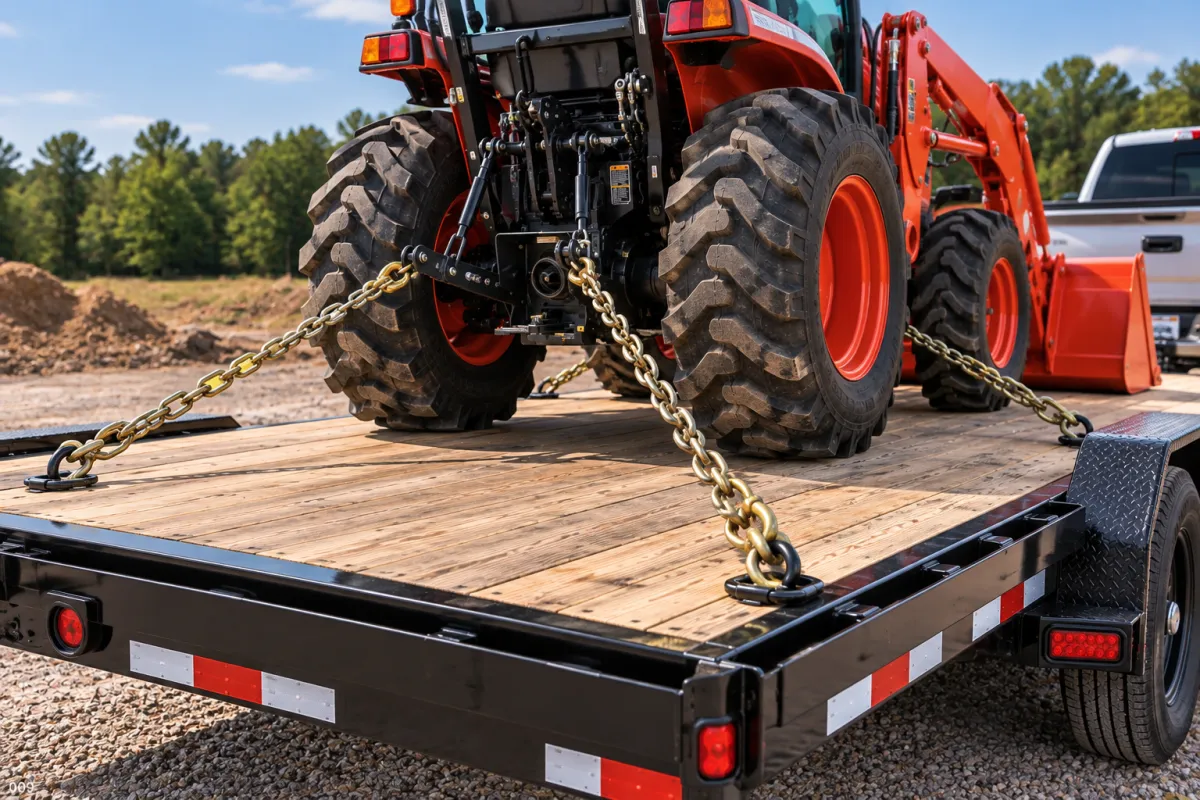
Chains and binders are for equipment with real weight and rough edges. Tractors, skid steers, and steel-framed machines. Chain does not stretch, does not cut on a sharp edge, and does not care about heat or grease.
For a tractor or skid steer on our tilt deck equipment trailer, chains are the right call. For a mower or ATV on the utility trailer, straps are fine.
Set the machine first
Before you tension anything, get the machine itself settled.
Lower a loader bucket all the way to the deck. Lower any three-point implement. Put the machine in gear or park, set the parking brake, and shut it off.
A lowered bucket sitting on the deck removes a lot of bounce and takes weight off the front axle. It also lowers the center of gravity, which makes the whole trailer more stable.
Tension in a pattern
Snug all four straps first. Do not fully tighten one before you touch the others.
Then go around a second time and bring each one to full tension. Working in a pattern keeps the load centered instead of pulling it toward whichever corner you tightened first.
Tighten until the strap is firm and the suspension of the load compresses slightly. You do not need to lean on the ratchet handle with your full body weight. Overtightening can damage a strap, bend a tie-down point, or crush something on the load.
Secure the loose ends
Every loose strap tail needs to be tied off, rolled, or tucked. A strap end flapping at 60 mph will fray in a hurry, and it can slap a passing vehicle.
Same for chain. Bind up the slack so nothing hangs down near a tire or the road.
Check again after a few miles
This is the step that matters most, and it is the one people skip.
Pull over somewhere safe after five or ten minutes and check every tie-down. Loads settle. Tires compress. A machine shifts a fraction of an inch into place. Straps that were tight in the driveway are often noticeably looser now.
Retension anything that has gone slack. Then check again at your next stop.
On a longer haul, check every hour or so. It takes two minutes.
The short version
Use real anchor points. Use four of them. Aim for about 45 degrees. Add up your working load limits and make sure they cover at least half the load weight. Lower everything that lowers. Tighten in a pattern. Tie off the ends. Then check again after a few miles.
If you are unsure about a specific load, ask us before pickup. Get in touch or browse our trailers.
Serving Montevallo, Alabaster, Pelham, Calera, Helena, and the south Birmingham metro.
