Working Load Limit vs. Breaking Strength: What’s the Difference?
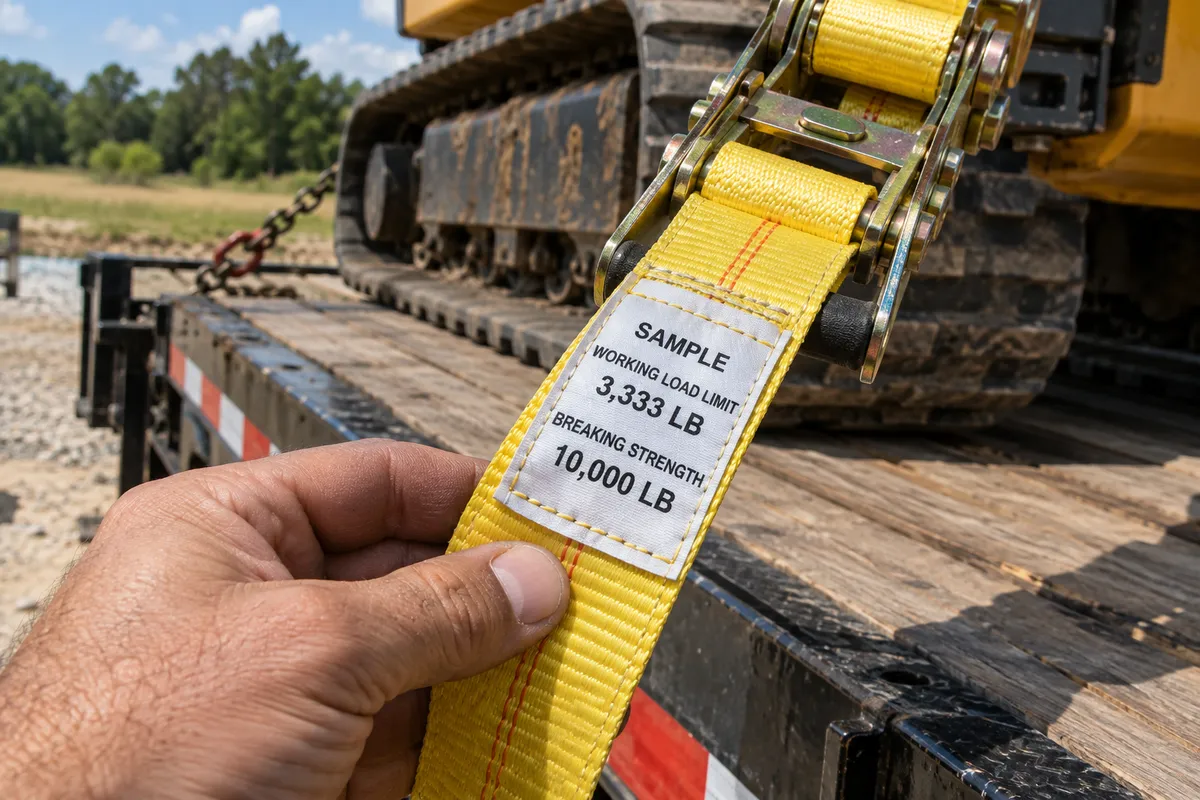
What is the difference between working load limit and breaking strength? Breaking strength is where a strap or chain fails. Working load limit is the most you should ever put on it, and it is usually about one third of the breaking strength.
Use the wrong number and you can be badly overloaded while thinking you have plenty of margin.
## What each number means
**Breaking strength** is the force at which the item fails in a lab test. It is sometimes called minimum breaking strength or tensile strength.
It is a manufacturing and engineering figure. It is not a number you should ever plan against.
**Working load limit**, or WLL, is the maximum load the manufacturer says the item should carry in normal use. It is typically one third of the breaking strength, giving a 3:1 safety factor.
This is your number. Always.
## Why the safety factor exists
A strap does not just hold a static weight. It absorbs shock.
Every bump, pothole, hard brake, and sharp turn sends a spike of force through the tie-down that is far higher than the load's resting weight. Hitting a pothole at 55 mph can momentarily multiply the force on a strap several times over.
The safety factor absorbs those spikes. Load to the breaking strength and the first real bump takes you past it.
Straps also lose strength as they age. Sun damage, abrasion, dirt ground into the fibers, and repeated tensioning all reduce capacity. A strap that met its rating new does not necessarily meet it after two seasons in a truck bed.
## Where to find the numbers
**Ratchet straps** have a sewn-in tag near the ratchet. It lists the WLL and often the breaking strength too. Read carefully, because the bigger number is the one you should ignore.
**Chains** have the grade stamped into the links. Grade 70 transport chain is the standard for equipment securement, marked with a "7" or "70."
The WLL depends on grade and link diameter. A 3/8" Grade 70 chain has a very different rating from a 1/4" chain of the same grade.
**Binders and hooks** have their own stamped ratings. The weakest piece in the assembly sets the limit for the whole thing. A chain rated at 6,600 lbs with a binder rated at 3,000 lbs is a 3,000 lb setup.
**If you cannot read the rating, do not use the item.** An unmarked strap is an unknown strap.
## The rule for how much you need
Add up the working load limit of every tie-down holding the load. The total should be at least **half the weight of what you are hauling.**
A 4,000 lb machine needs tie-downs totaling at least 2,000 lbs of WLL.
Four straps rated at 500 lbs WLL each gives you 2,000 lbs. That works for a 4,000 lb load.
Four straps rated at 500 lbs WLL do **not** work for a 6,000 lb load. You would need 3,000 lbs of total WLL.
This is why a tractor gets chains and a mower gets straps. Chains carry much higher working load limits.
## Angles change the math
A tie-down does not deliver its full WLL unless it pulls in line with the load.
A strap at a shallow angle holds less effectively against downward movement. A strap at a steep angle holds down well but does very little against sliding.
Roughly 45 degrees gives you a useful balance of both. Aim for that, and use four points rather than two so you are covered in every direction.
Braking is where most loads shift, and braking throws the load forward hard. Front tie-downs pulling forward and outward are what stop that.
Our post on [securing a load on a trailer](https://woodfieldtrailerrentals.com/blog/how-to-secure-a-load-on-a-trailer) covers the four-point pattern in detail.
## Things that quietly reduce your rating
**Knots.** A knot in a strap can cut its strength substantially. Never knot a strap to make it fit.
**Sharp edges.** Webbing running over a steel corner can be most of the way through before you see it. Use corner protectors.
**Damage.** Cuts, holes, frayed edges, and worn spots all reduce capacity, and you cannot tell by how much.
**Sun.** UV degrades webbing. Stiff, faded, chalky straps have lost strength even if they look intact.
**Bent hooks.** A deformed hook has been overloaded already. Retire it.
## When to retire something
Throw away a strap or chain if you see cuts, nicks, or frayed edges; holes or worn-through spots; stiff or chalky webbing; a bent, cracked, or stretched hook or link; a ratchet that will not lock; or a missing rating tag.
Tie-downs are inexpensive. Replacing a questionable one costs less than almost any other decision in this whole process.
## The short version
Working load limit is your number. Breaking strength is not. Add up the WLL of every tie-down and make sure it covers at least half the load weight. Check the tags before every trip, and retire anything damaged.
Then recheck your tie-downs after the first few miles, because loads settle and tension drops.
Questions about securing a specific load? [Get in touch](https://woodfieldtrailerrentals.com/contact-us) before pickup.
Serving Montevallo, Alabaster, Pelham, Calera, Helena, and the south Birmingham metro.
Back to Blog