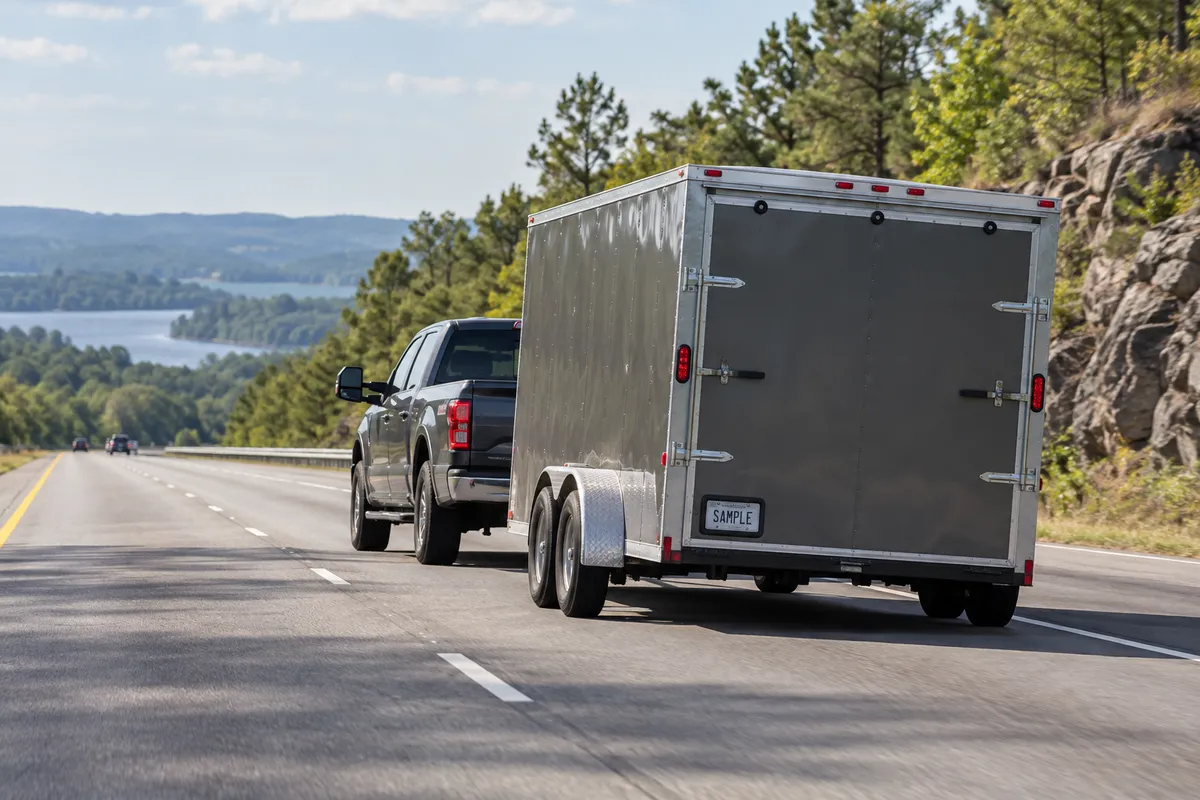
What to Do If Your Trailer Starts Swaying
Your trailer starts swinging side to side at 60 mph. What do you do? Ease off the gas, keep the wheel straight, and if you have a brake controller, use the manual lever to apply the trailer brakes only.
What you do not do is hit the brakes or steer against it. Both make it worse.
Here is why, and how to keep it from happening at all.
What sway actually is
A trailer follows your truck because the tongue is pinned to the hitch. That pin is a pivot point.
When something pushes the trailer sideways, a gust of wind, a passing semi, a quick lane change, the trailer swings around that pivot. Then it swings back.
If the trailer is loaded correctly, that swing damps out and settles in a second or two. If it is loaded badly, each swing pushes the truck slightly, which pushes back harder, and the motion grows instead of shrinking.
That growing oscillation is sway. It builds fast, and it usually happens at highway speed because that is where there is enough energy to feed it.
What to do, in order
1. Ease off the accelerator. Do not stab it, do not lift abruptly. Just let off smoothly. Lower speed takes energy out of the system.
2. Keep the steering wheel straight. Your instinct is to steer against the swing. Fight that instinct. Steering corrections arrive out of phase with the oscillation and amplify it. Hold the wheel firmly and let the truck track straight.
3. Use the manual trailer brake lever. If you have a brake controller, there is a lever or slider on it that applies the trailer brakes without the truck brakes. Apply it gently and steadily.
This works because it pulls the trailer straight from behind. It stretches the combination out instead of pushing it into a jackknife.
4. Do not use the truck brakes. Braking the truck transfers weight forward, unloads the rear axle, and pushes the trailer into the truck. That is exactly the wrong direction.
5. Once it settles, pull over. Somewhere safe and level. Do not just slow down and keep going, because whatever caused it is still there.
Then find the cause
Sway is almost always a loading problem. Three things to check.
Tongue weight too low. This is the most common cause by far. Tongue weight should be 10 to 15 percent of the loaded trailer weight. Below 10 percent, the trailer behaves like a lever instead of a follower.
Look at the trailer. Sitting nose-high? The load is too far back.
Load too far rearward. About 60 percent of the weight should sit ahead of the axles. On a tandem-axle trailer, the balance point is between the two axles.
Move the load forward. Even eighteen inches makes a real difference on a short deck.
Load shifted during the trip. Straps loosen, machines settle. A load that started balanced can move. Check every tie-down.
Our post on distributing weight on a trailer covers placement in detail.
Other things that contribute
Speed. Sway gets dramatically worse above about 55 to 60 mph. If you are near your limits, slow down.
Tire pressure. Underinflated trailer tires flex and squirm, which lets the trailer wander. Check them cold and set them to the sidewall pressure, often 50 to 65 psi. Check your truck’s rear tires too.
A worn or loose hitch. Play in the coupler or ball mount lets movement start more easily. If the trailer clunks noticeably over bumps, that is worth investigating.
Crosswind and traffic. You cannot change these, but you can respect them. When a semi passes, ease off slightly and hold the wheel steady. Expect the push and be ready for it.
Around here specifically
Shelby County gives you a few places to be alert.
I-65 through Alabaster and Calera puts you next to a lot of truck traffic at speed, and that is prime sway territory. When a semi comes past, hold steady and let it go by.
Highway 25 and the roads toward Columbiana have grades and curves. A descent lets speed build without you noticing, which is when sway shows up.
Open stretches near Wilton and the county roads can carry real crosswind on gusty days.
Preventing it beats reacting to it
The whole problem is avoidable at the loading stage.
Sixty percent of the weight ahead of the axles. Tongue weight at 10 to 15 percent. Load centered side to side and as low as possible. Tires at correct pressure. Everything strapped tight.
Then judge the first mile honestly. A correctly loaded trailer feels boring and planted. If you feel any side-to-side wander at 45 mph, pull over and move the load forward. Do not tell yourself it will settle down at speed. It will get worse.
One more thing
If you have never towed at highway speed before, do not make your first experience a loaded run on I-65 at rush hour.
Take a shorter route at lower speed first. Get a feel for how the combination behaves, how long it takes to stop, and how much room you need to change lanes.
Questions about loading a specific job? Get in touch before pickup, or see our trailers.
Serving Montevallo, Alabaster, Pelham, Calera, Helena, and the south Birmingham metro.
