Trailer Rental in Shelby County: What to Know Before You Book
Renting a trailer in Shelby County for the first time? Most of what you need to know comes down to five things: what you are hauling, what you are towing with, what the law requires, how long you need it, and how pickup works.
Here is the rundown.
Know what you are hauling, in pounds
The single most useful thing you can bring to a rental conversation is a real weight.
Look up the operating weight of the machine. Look up the curb weight of the car. For loose material, do the math. Dry topsoil is about 2,000 lbs per cubic yard and gravel is closer to 2,700.
Then add the extras. Attachments, fuel, and anything riding along.
One thing that surprises people: a trailer’s GVWR is not what it can carry. Subtract the trailer’s empty weight to get the real payload.
Know your tow vehicle
Three numbers matter.
Tow rating is in your owner’s manual, in a table sorted by engine, cab, and drivetrain. Find your exact configuration.
Payload is on the sticker inside your driver’s door. It covers people, cargo, and the weight the trailer tongue puts on your hitch. It usually runs out before the tow rating does.
Combined weight rating caps the truck and trailer together, fully loaded.
Then check your hardware. Receiver class, ball size, and plug type. Most equipment trailers use a 2-5/16" ball. Smaller utility trailers usually use 2". A 4-pin plug runs lights only. Electric brakes need a 7-pin and a brake controller in the cab.
Our post on whether your truck can safely tow a rental trailer walks through each one.
Know the Alabama rules
A few state requirements worth knowing before you tow anything here.
Trailers at or above 3,000 lbs gross weight need their own brakes. Those brakes have to stop and hold the trailer, and they have to come on by themselves if the trailer separates from the truck.
Safety chains are required, and they have to be crossed under the coupler.
Trailer lights have to be visible from 500 feet, and your brake lights and turn signals have to carry through to the trailer.
Maximum trailer width is 8 feet on most roads. Maximum height is 13 feet 6 inches.
Your auto insurance is what typically covers a trailer you tow. Confirm that with your provider before pickup rather than assuming.
Think about timing
Weekend demand around here is real, especially in spring and fall when everyone is doing yard projects, moves, and food plots at the same time.
For a flexible weekend job, a few days’ notice is usually plenty. For a date tied to a closing, a job site, or a service appointment, book as early as you can.
Longer bookings usually cost less per day. If your project might run into a second day, it is often cheaper to book two days up front than to extend later. And a job that “should take four hours” frequently does not.
Know what fits our fleet
We run two trailers, and they cover different jobs.
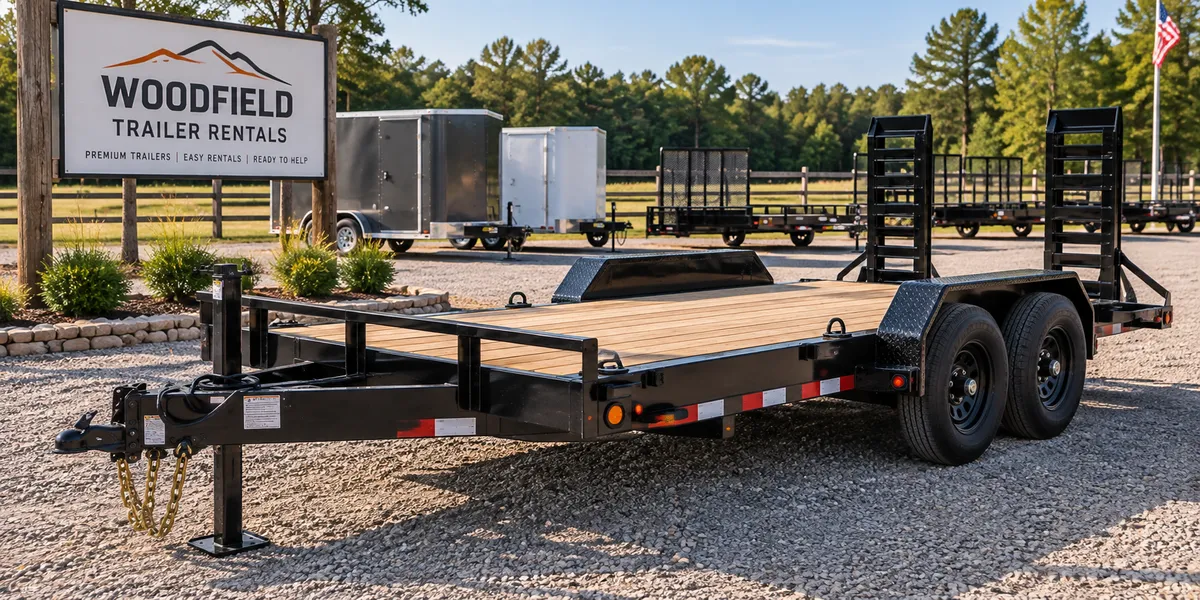
The tilt deck equipment trailer is 20 feet by 6’ 11" with a 14,000 lb GVWR. The deck lowers hydraulically to one smooth slope, so tractors, skid steers, mowers, and vehicles drive straight on without bottoming out at a ramp joint.
The utility trailer is 10’ x 6’ with a 3,000 lb GVWR. It is the right tool for lumber runs, brush and yard debris, appliances, furniture, ATVs, and general cargo.
If your load does not fit either one, we will tell you. Sending someone out with the wrong trailer helps nobody.
Understand how pickup works
Our rentals are built to be simple. You book online, sign and pay, and get your access code by text. The trailer is staged and ready when you arrive. You hook up, haul, and return it.
You can read the full process on our how it works page.
Bring your own tie-downs unless you have confirmed otherwise, and make sure your ball and plug match the trailer before you leave home. Those two things are the most common reasons a pickup goes sideways.
We also deliver within 50 miles if hooking up yourself is not practical.
Plan for the roads you will actually drive
Shelby County is hilly. Highway 25, the climbs around Montevallo, and the two-lane stretches toward Columbiana and Wilton all ask more of a loaded truck than flat highway does.
Loaded, your stopping distance goes up a lot. Leave extra following room. Take turns wider than normal, because the trailer cuts inside your line. Slow down before a curve rather than in it.
If you have not towed in a while, plan a route you know and give yourself extra time.
Before you book, have these ready
- What you are hauling and roughly what it weighs
- Your truck’s year, make, model, cab and bed, and drivetrain
- Your ball size and plug type
- Whether you have a brake controller
- The dates you need it
With that in hand, the whole thing usually takes a couple of minutes.
Questions about a specific load? Get in touch.
Serving Montevallo, Alabaster, Pelham, Calera, Helena, Columbiana, and the south Birmingham metro.
