Trailer Payload Capacity: How Much Can You Actually Haul?
How much can a trailer really carry? Less than the big number on the sticker. That number is GVWR, and it includes the weight of the trailer itself. Confusing those two is the most common and most expensive mistake in trailer rental.
Here is how the math actually works.
The three numbers that matter
GVWR is the gross vehicle weight rating. It is the most the loaded trailer is allowed to weigh, trailer and cargo combined.
Empty weight is what the trailer weighs by itself, sometimes called curb weight or tare weight.
Payload is what you can put on it. It is simply GVWR minus empty weight.
That subtraction is the whole thing. A trailer with a 14,000 lb GVWR that weighs 3,500 lbs empty has a payload of 10,500 lbs, not 14,000.
Skip the subtraction and you can be over your limit while thinking you have thousands of pounds to spare.
Where to find the numbers
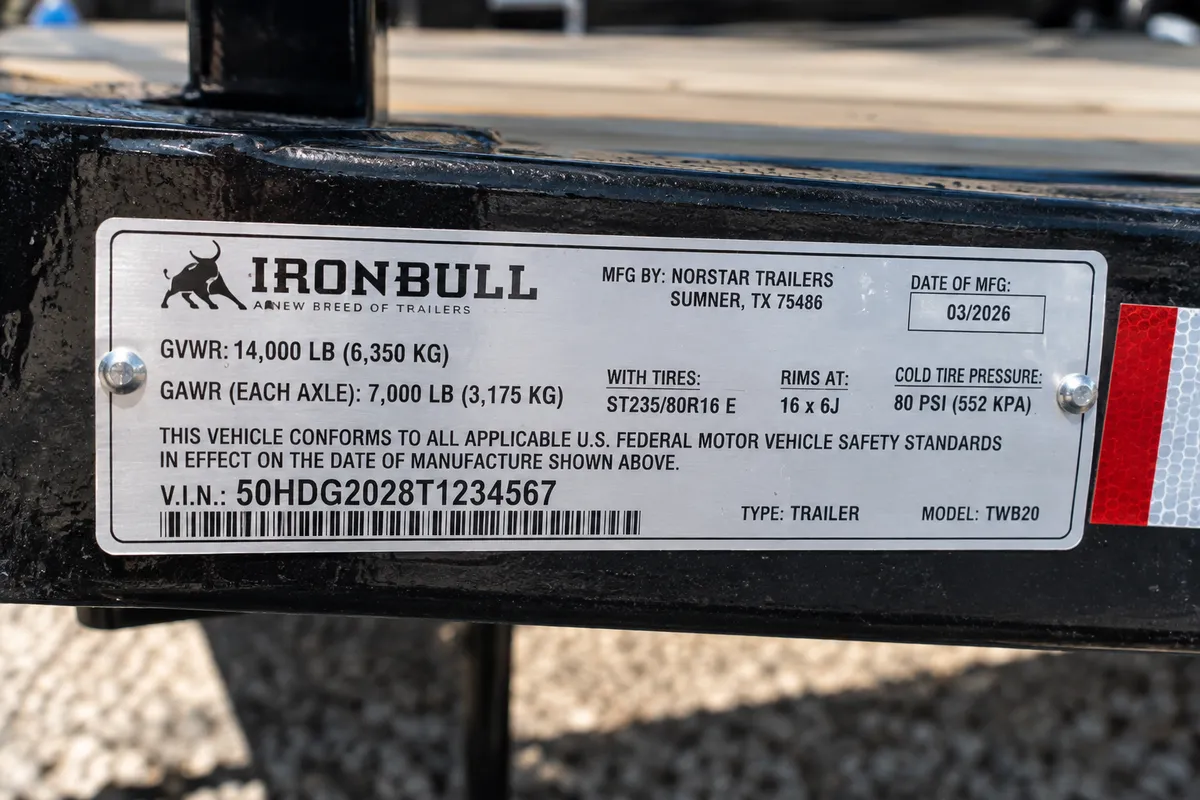
The GVWR is on the VIN plate, usually on the trailer’s tongue or the front left side of the frame. It is a metal or foil sticker with the manufacturer, VIN, GVWR, and axle ratings.
Empty weight is sometimes on that same plate. Often it is not. When it is not, ask. We know what ours weigh.
If nobody knows, a certified scale settles it. Many landscape supply yards, quarries, and truck stops have one.
Axle ratings matter too
The VIN plate also lists GAWR, the gross axle weight rating, for each axle.
Your load has to stay under the total GVWR and under each individual axle rating. It is possible to be under GVWR overall but overloaded on one axle if the weight is bunched at one end.
That is another reason placement matters, not just total weight.
Our two trailers, in real numbers
The tilt deck equipment trailer has a 14,000 lb GVWR on a 20’ x 6’ 11" deck. Subtract the trailer’s own weight and you still have plenty of capacity for compact tractors, skid steers, mowers, and vehicles.
The utility trailer is 10’ x 6’ with a 3,000 lb GVWR. Subtract the empty weight and the usable payload is meaningfully under 3,000 lbs. That trailer is built for volume more than tonnage.
If you need the exact empty weight for a load you are cutting close on, ask us and we will give it to you.
Weighing your load honestly
Guessing is where people get in trouble. A few common items and what they really weigh:
- Dry topsoil: about 2,000 lbs per cubic yard
- Gravel: about 2,700 lbs per cubic yard
- Wet material: add 10 to 25 percent
- Pallet of pavers: often 2,500 to 3,500 lbs
- Compact tractor with loader: 3,000 to 5,500 lbs
- Skid steer: 4,500 to 8,000 lbs
- Mid-size sedan: 3,000 to 3,600 lbs
- Zero-turn mower: 600 to 1,200 lbs
Then add the extras. Attachments, fuel, tools riding along, and the chains and straps themselves. Those add 50 to 150 lbs on a serious load.
For machines, always add attachments separately. A loader adds 700 to 1,200 lbs. Fluid-filled tires add 400 to 800 lbs and are invisible.
Payload is not the only limit
Even a load within the trailer’s payload can be a problem if your truck cannot handle it.
Your tow rating caps the total trailer weight, meaning trailer plus load. Your truck’s payload caps what sits in and on the truck, including the tongue weight the trailer puts on your hitch. Your combined weight rating caps everything together.
Tongue weight is usually 10 to 15 percent of loaded trailer weight, and it comes out of your truck’s payload. On a 10,000 lb loaded trailer that is 1,000 to 1,500 lbs. Many half-ton trucks do not have that much payload left after the driver and gear.
Our post on whether your truck can safely tow walks through those numbers.
What overloading actually does
It is not a paperwork problem.
Tires are rated for a specific load. Past that, heat builds and blowouts follow. Axles and bearings wear fast and can fail. Brakes fade when they are asked to stop more than they were designed for, and stopping distance climbs.
In a crash, being over the rating changes the liability picture considerably. Your insurance company will ask.
The habit worth building
Before every haul, do this in your head:
GVWR minus empty weight equals payload. Is my load under that? Is it under each axle rating? Is the total trailer weight under my tow rating? Is the tongue weight under what my truck’s payload can spare?
Four questions, thirty seconds. Do it every time until it is automatic.
If you want help running the numbers for a specific load, tell us what you are hauling and what you are towing with. Get in touch.
Serving Montevallo, Alabaster, Pelham, Calera, Helena, and the south Birmingham metro.
