Trailer GVWR Explained in Plain English
What does GVWR mean on a trailer? It is the most the trailer is allowed to weigh in total, loaded, including the trailer itself.
That last part is where people go wrong. GVWR is not how much you can put on it.
The three numbers, plainly
GVWR is gross vehicle weight rating. Trailer plus cargo, the maximum allowed total.
Empty weight is what the trailer weighs by itself with nothing on it. You will also see this called curb weight or tare weight.
Payload is what you can actually load. It is GVWR minus empty weight.
A trailer with a 14,000 lb GVWR that weighs 3,500 lbs empty can carry 10,500 lbs. Not 14,000.
Miss that subtraction and you can be badly overloaded while believing you have thousands of pounds to spare.
Why the number exists
GVWR is not a suggestion from the marketing department. It is set by the manufacturer based on the weakest link in the trailer.
The frame can only take so much. The axles are rated. The springs, the bearings, the wheels, the brakes, and the tires all have their own limits. GVWR reflects whatever gives out first.
That is why you cannot raise it by adding a heavier-duty part somewhere. The rating is for the whole assembly as built.
Where to find it
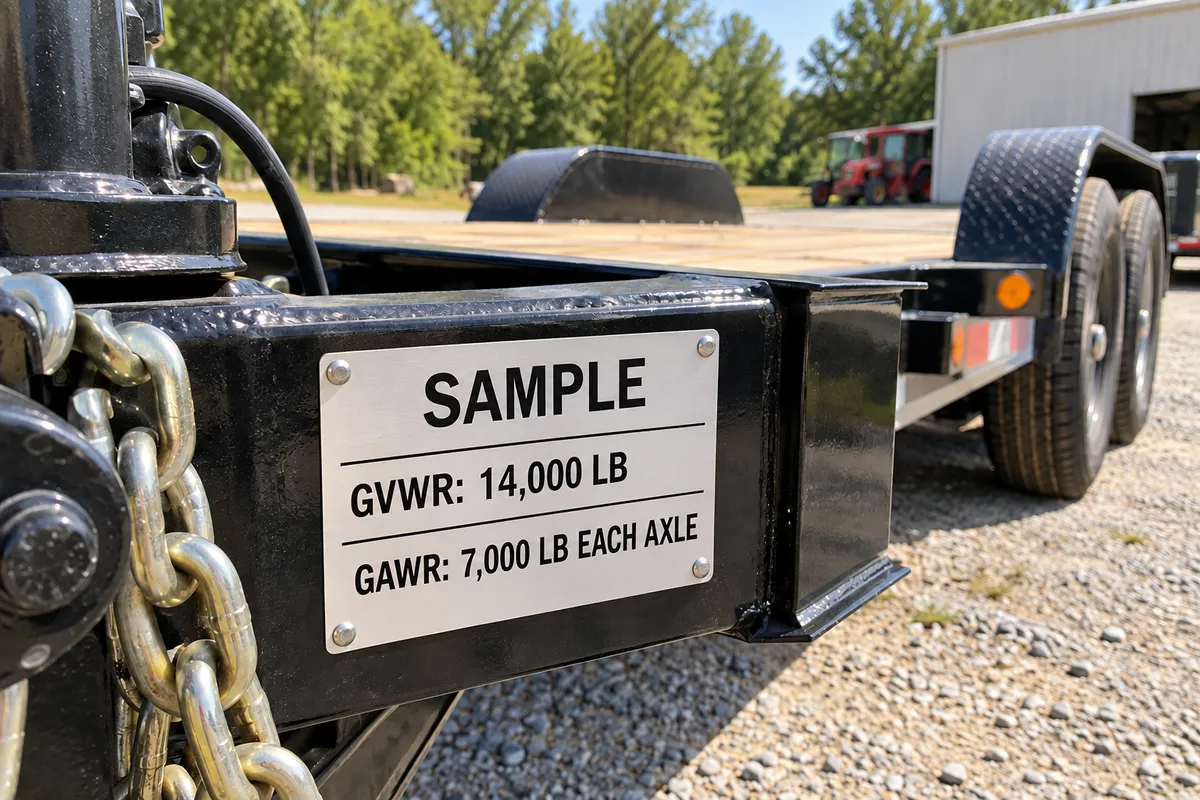
Look for the VIN plate. It is usually a metal or foil sticker on the trailer tongue or the front left side of the frame.
It lists the manufacturer, the VIN, the GVWR, the tire and rim specs, and the GAWR for each axle.
Empty weight is sometimes on that plate and sometimes not. When it is not, ask. We know what ours weigh.
If nobody knows, a certified scale settles it. Landscape supply yards, quarries, and truck stops often have one.
GAWR is a separate limit
That same plate lists GAWR, the gross axle weight rating, for each axle.
Your load has to stay under the total GVWR and under each individual axle rating.
You can be under GVWR overall and still overload one axle if the weight is bunched at one end. That is another reason placement matters, not just total weight.
GVWR is not GCWR, and neither is your tow rating
Three similar-sounding numbers that mean different things:
GVWR (trailer) caps the loaded trailer.
GVWR (truck) caps your loaded truck, including passengers, cargo, and the tongue weight pressing down on the hitch.
GCWR caps the truck and trailer together, fully loaded. This is the ceiling on the whole combination.
Tow rating is how much trailer your truck is rated to pull.
You have to satisfy all of them. Being under your tow rating does not help if you are over on your truck’s payload, which is the limit that usually runs out first.
What our trailers mean in practice
Our tilt deck equipment trailer has a 14,000 lb GVWR on a 20’ x 6’ 11" deck. After subtracting the trailer’s own weight, there is real capacity left for compact tractors, skid steers, and vehicles.
Our utility trailer is 10’ x 6’ with a 3,000 lb GVWR. Subtract the empty weight and the usable payload is meaningfully under 3,000 lbs. That trailer is built for bulky loads more than heavy ones.
If you are cutting a load close, ask us for the exact empty weight and we will give it to you.
GVWR and the Alabama brake rule
Alabama requires trailers at or above 3,000 lbs gross weight to have their own brakes that can stop and hold the trailer, and those brakes have to engage automatically if the trailer breaks away.
Note the wording: gross weight, meaning trailer plus load. A 1,500 lb trailer carrying a 2,000 lb mower is a 3,500 lb gross weight trailer, and the rule applies.
That means you may need a brake controller in your truck and a 7-pin connector to run it. Our post on brake controllers covers how to tell what you have.
What overloading actually costs you
It is not a paperwork issue.
Tires are rated for a specific load. Past that, heat builds and blowouts follow, usually at highway speed. Bearings run hot and fail. Brakes fade and stopping distance grows, right when you have more weight to stop.
In a crash, exceeding the rating changes the liability picture. Your insurance company will look at it.
The habit
Before every haul: GVWR minus empty weight equals payload. Is my load under that? Is it under each axle rating? Is the total under my tow rating, and is the tongue weight within what my truck’s payload can spare?
Four questions, thirty seconds.
Need help running the numbers? Get in touch.
Serving Montevallo, Alabaster, Pelham, Calera, Helena, and the south Birmingham metro.
