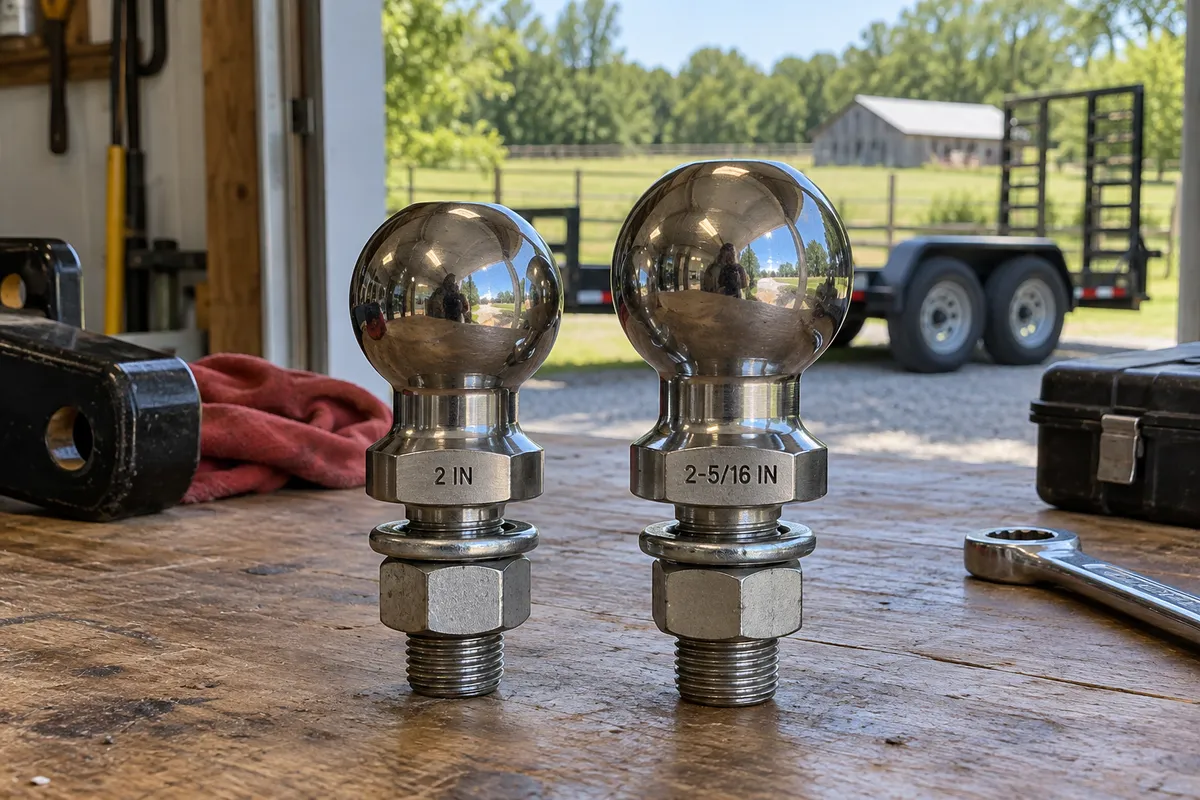
2" vs. 2-5/16" Trailer Ball: How to Know What You Need
Which trailer ball do you need? Whatever size is stamped on the trailer’s coupler. It is not a preference or a judgment call. The coupler tells you, and the two sizes are not interchangeable.
Here is how to check and why it matters so much.
Read the coupler
Look at the underside or the side of the coupler on the trailer tongue. The required ball size is stamped or cast into the metal.
You will see either 2" or 2-5/16". Some couplers also list a maximum weight rating right beside it.
That stamp is the answer. Match it exactly.
Read the ball
Your ball also has its size stamped on the top of it, along with a weight rating.
If the stamp is worn off or painted over, measure the ball across its widest point with a tape or calipers. Five-sixteenths of an inch is a visible difference once you know to look, but it is easy to miss at a glance.
Why a mismatch is dangerous
Here is the failure that hurts people.
A 2" ball will drop into a 2-5/16" coupler. The coupler is bigger, so the ball fits with room to spare. In many cases the latch will even close, because the latch closes under the ball’s shoulder and there is enough clearance for it to swing shut.
It looks connected. It is not.
The ball is too small to be captured properly. The first hard bump, dip, or hard brake lifts the coupler enough to come off the ball entirely. Now you have a loaded trailer connected to your truck only by the safety chains, if you attached them correctly, and by nothing at all if you did not.
The reverse, a 2-5/16" ball under a 2" coupler, simply will not seat. The coupler will sit on top of the ball and the latch will not close. That one is obvious and self-correcting.
The dangerous direction is the small ball in the big coupler, because it feels fine right up until it does not.
Which size goes with which trailer
Rough guide, but always verify against the coupler stamp:
2" ball. Smaller utility trailers, single-axle trailers, small boat trailers, light landscape trailers. Typically rated up to about 3,500 to 5,000 lbs depending on the specific ball and mount.
2-5/16" ball. Equipment trailers, car haulers, larger tandem-axle trailers, heavier dump trailers. Ratings commonly run from about 10,000 lbs up past 20,000 lbs.
Our utility trailer and our tilt deck equipment trailer do not use the same size. Ask us which you need before you drive out.
Size is not the only rating
Getting the diameter right is step one. The ball also has a weight rating stamped on it, and so does the ball mount, and so does the receiver.
The whole chain matters. A 2-5/16" ball rated for 14,000 lbs bolted into a ball mount rated for 6,000 lbs gives you a 6,000 lb setup. The weakest piece sets the limit.
Check all three: receiver class stamped on the receiver, ball mount rating stamped on the shank, ball rating stamped on top.
Shank diameter is a separate thing
The threaded stem under the ball, the shank, has its own diameter, commonly 3/4", 1", or 1-1/4".
It has to match the hole in your ball mount. A 1" shank in a 1-1/4" hole leaves slop that will elongate the hole and eventually shear.
When you buy a ball, you are choosing both the ball diameter and the shank diameter. They are independent.
Torque the nut properly and use a lock washer. A ball that works loose is another way this fails.
Get the height right too
Ball size does not affect trailer height, but the ball mount does.
You want the trailer sitting level once hooked up. A trailer that is nose-high shifts weight rearward and increases sway risk. Nose-low overloads the front axle and puts extra weight on the hitch.
Measure the height from the ground to the bottom of the coupler with the trailer level. Measure from the ground to the top of your receiver opening. The difference tells you how much drop or rise you need in the ball mount.
Adjustable ball mounts solve this, and many come with both a 2" and a 2-5/16" ball on a reversible or dual-ball head. If you tow different trailers, that is a worthwhile purchase.
Before you leave the house
Confirm the coupler size on the trailer you are renting. Confirm the ball you own matches. Confirm the ball’s weight rating covers the loaded trailer. Confirm the drop gives you a level trailer.
Then, once hooked up, do the lift test. With the latch closed and pinned, crank the jack down until it starts to raise the back of the truck. If the coupler is seated correctly, the truck rises. If it pops off, it was never seated.
That test takes ten seconds and catches the mismatch before you are on the road.
Not sure what you need? Tell us what you are renting and what hardware you have. Get in touch or read our guide on hooking up a trailer.
Serving Montevallo, Alabaster, Pelham, Calera, Helena, and the south Birmingham metro.
