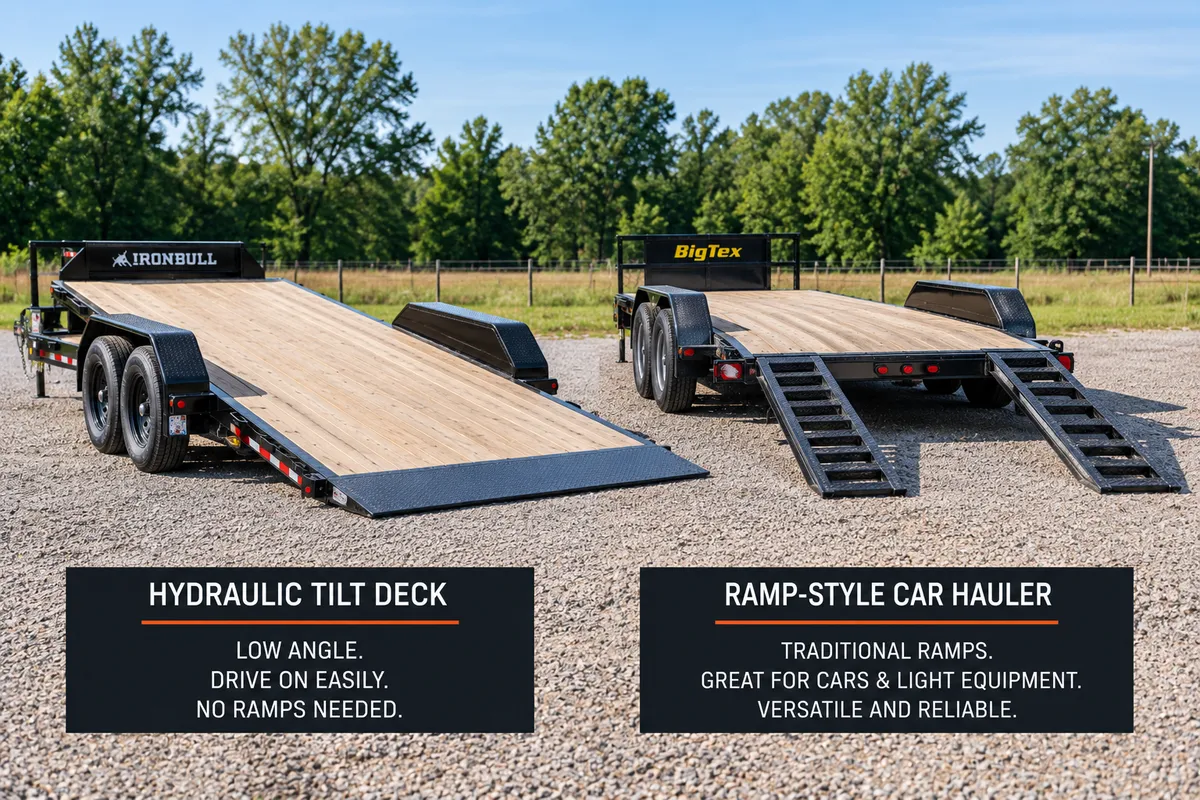
Tilt Trailer vs. Car Hauler: Which One Do You Need?
Tilt trailer or car hauler? The short answer is that a tilt trailer solves loading problems and a car hauler solves length problems. If your load is low to the ground or awkward to drive on, the tilt deck usually wins.
Here is how the two differ and when each one makes sense.
How a tilt trailer works
A tilt trailer has a deck that pivots. Release it, and the whole back end lowers to the ground, forming one continuous shallow slope from the pavement up to the deck.
There are no separate ramps and no joint where a ramp meets the deck. The load rolls up a single smooth surface.
Most tilt decks on equipment trailers are hydraulic, so the deck lowers and raises under control rather than dropping under the weight of the load.
How a car hauler works
A traditional car hauler is a flat deck with ramps that slide out or fold down from the back.
The ramps bridge the gap between the ground and the deck. Where the ramp meets the deck, there is a bend. That bend is the break-over point, and it is the source of most car hauler loading trouble.
Car haulers are usually built with vehicles in mind, so they tend to be long, sometimes with a beavertail, and they often include a winch mount.
The break-over problem
This is the real difference between the two.
Picture a low sports car going up a ramp. The front tires climb, the nose rises, and then the middle of the car reaches the bend where the ramp meets the deck. The car’s belly can scrape or hang up right there.
Same story with a tractor. The loader bucket out front can dig into the ramp before the front tires even reach the deck. A long-wheelbase machine can rest on the bend with both axles off the ground.
A tilt deck removes the bend entirely. One slope, no transition point. That is why it handles low cars, long tractors, and awkward machines better.
When a tilt trailer is the right call
Anything low to the ground. Sports cars, lowered vehicles, and low-clearance equipment.
Long-wheelbase machines. Compact tractors with loaders and implements, where the distance between axles makes the break-over angle a real risk.
Skid steers and compact equipment. Short and heavy, but often with low clearance under the frame.
First-time loaders. The tilt deck is simply less to go wrong. No ramps to set, align, or pin.
Wet or slick conditions. A single continuous surface gives more predictable traction than a two-piece ramp setup.
Our tilt deck equipment trailer is 20 feet by 6’ 11" with a 14,000 lb GVWR. That combination of deck length, width, and hydraulic tilt covers most compact tractors, skid steers, mowers, and vehicles people move around Shelby County.
When a dedicated car hauler makes more sense
Multiple vehicles. Some car haulers are built long enough for more than one.
Non-running vehicles with a built-in winch. If the car will not start and the trailer has a winch already mounted, that is convenient.
Very long vehicles. An extended cab dually or a stretched vehicle may need more deck than a general equipment trailer offers.
Frequent, repeated car transport. If this is your regular job, purpose-built beats general-purpose.
For most one-off vehicle moves, though, a tilt deck of adequate length does the job well and handles a wider range of other loads besides.
Deck length is its own question
Whichever type you pick, length matters for balance.
You need enough deck to put about 60 percent of the load’s weight ahead of the axles. If the vehicle barely fits end to end, you cannot position it correctly, and a rear-heavy trailer sways.
Measure your load, then add three to four feet of working room. That tells you the minimum deck length you actually need.
What both types demand from your truck
Deck type does not change the towing math.
Check your tow rating in the owner’s manual for your exact configuration. Check your payload on the door sticker. Check that the tongue weight, usually 10 to 15 percent of the loaded trailer weight, fits within your remaining payload.
Confirm your ball size. Most equipment trailers use 2-5/16". Confirm your plug. Electric brakes need a 7-pin and a brake controller in the cab.
Alabama requires brakes on trailers at or above 3,000 lbs gross weight, with automatic engagement if the trailer breaks away, plus crossed safety chains.
Making the call
Ask yourself two questions.
How low is the load, and how long is its wheelbase? If the answer to either is “pretty low” or “pretty long,” go with the tilt deck.
Is this specifically about moving cars, repeatedly, possibly more than one at a time? Then a dedicated car hauler earns its keep.
For everything in between, which is most jobs, a tilt deck of the right length is the more flexible tool.
Not sure which way to go? Tell us what you are moving, its rough weight, and its ground clearance. Get in touch or see our trailers.
Serving Montevallo, Alabaster, Pelham, Calera, Helena, and the south Birmingham metro.
