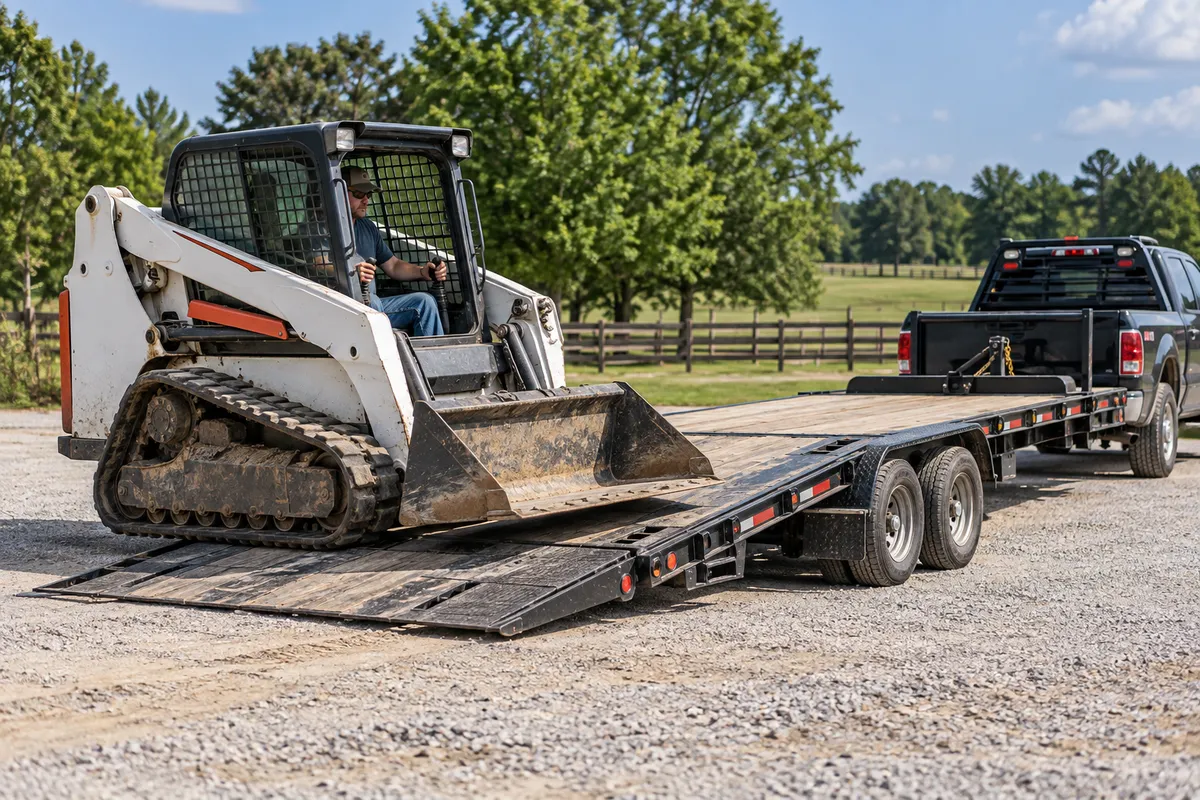
How to Safely Load Equipment Onto a Trailer
What causes most trailer loading accidents? Not the weight. It is the ground, the angle, and where people are standing. Fix those three and loading becomes routine.
Here is how to do it right, whatever you are loading.
Set up before anything moves
Find level ground. This matters more than everything else combined. On a slope, the ramp angle changes and the machine can shift as it crosses onto the deck. On a side slope, it can lean as weight transfers.
If you truly cannot find flat ground, point the trailer uphill rather than parking across the slope.
Keep the trailer hitched. Do not unhook to load. An unhitched trailer can tip forward or back when the machine’s weight crosses the axles.
Set the truck. In park, parking brake on. In gear if it is a manual.
Chock the trailer wheels. Ten seconds, and it removes any chance of the trailer rolling.
Clear the deck. Sweep off mud, gravel, leaves, and anything left from the last load. Loose material under a tire is how a machine slides sideways.
Check your clearance before you commit
Look at the lowest point on your machine and picture it crossing the slope.
With ramps, there is a bend where the ramp meets the deck. That bend is the break-over point, and it is where low machines with long wheelbases get hung up. A tractor with a loader can catch the bucket before the front tires even reach the deck.
A hydraulic tilt deck removes that bend by lowering the whole rear of the trailer into one continuous shallow slope. That is why our tilt deck equipment trailer handles low and long machines well.
If you are using ramps, make sure they are fully seated and pinned, spaced correctly for your machine’s track width, and rated for the weight.
Approach straight and slow
Line up before you start. Not partway up.
If you are crooked when the front wheels hit the ramp, back off, reset, and start again. It costs thirty seconds. Correcting an angle on a ramp is how machines go off the edge.
Idle speed, low gear. Slower than feels necessary.
Do not stop halfway. Interruptions in the middle of the ramp are where things go wrong. Pick your line, commit, and roll on steadily.
Keep steering input minimal. Small corrections only.
Which way to point it
The goal is about 60 percent of the weight ahead of the trailer’s axles. So point the heavy end forward.
Tractors usually load nose first. Engine and loader are up front.
Skid steers usually have the engine at the rear, so backing on often puts the heavy end forward. Check yours.
Zero-turn mowers typically have the engine at the back, so backing on frequently balances better.
Cars are usually nose first, since the engine is up front.
If you are unsure, look at the machine and ask which end feels heavy when you lift it. That end goes forward.
Where nobody stands
This is the part that keeps people alive.
Never stand behind a machine being loaded. If it loses traction and rolls back, there is nowhere for you to go.
Never stand beside the ramps. A machine that slips off the edge comes down fast and there is no warning.
If you have a spotter, put them well off to the side and forward of the trailer, where the operator can see them and they are clear of any path the machine could take.
Keep everyone else, especially kids, away from the whole area.
Wet changes everything
A wet deck or wet ramps cut traction badly, and a machine that starts sliding on a ramp is very hard to stop.
If it is raining or the deck is wet, wait if you can. If you cannot, go slower still, and be honest about whether the load is worth it.
Steel ramps and a wet steel deck are the worst combination. Wood decks hold a little better but not much.
Once it is on
Position it, then shut it down properly.
Lower the loader bucket all the way to the deck. Lower any three-point implement. This drops the center of gravity and takes bounce out of the ride.
Transmission in park or in gear. Parking brake set. Engine off. Take the key.
Then secure it with four-point tie-downs, angled out and down at roughly 45 degrees, connected to real anchor points on both the machine and the trailer. Our post on securing a load covers the details.
Unloading is where people relax
Same rules, and this is the stage where habits slip.
Level ground. Trailer still hitched. Wheels chocked. Remove tie-downs only when nobody is in the machine’s path. Raise implements just enough to clear the deck. Roll off slowly and straight.
Do not release the last chain and then walk behind the machine.
The short version
Level ground, dry deck, hitched trailer, chocked wheels. Clear the deck. Check your clearance. Straight approach, slow speed, no stopping partway. Heavy end forward. Nobody behind or beside. Lower everything, shut it down, secure it.
Questions about a specific machine? Get in touch or see our trailers.
Serving Montevallo, Alabaster, Pelham, Calera, Helena, and the south Birmingham metro.
