Ratchet Straps 101: How to Use Them Correctly
Why do ratchet straps come loose? Usually because of how they were threaded, not how hard they were cranked. Getting the webbing through the spool correctly matters more than muscle.
Here is how to use them properly.
The parts
A ratchet strap has two pieces.
The short end has the ratchet mechanism and a fixed length of webbing with a hook.
The long end is loose webbing with a hook on it. This is the piece you feed through the ratchet.
Both hooks attach to anchor points. The ratchet does the tightening.
Threading it right
This is where most problems start.
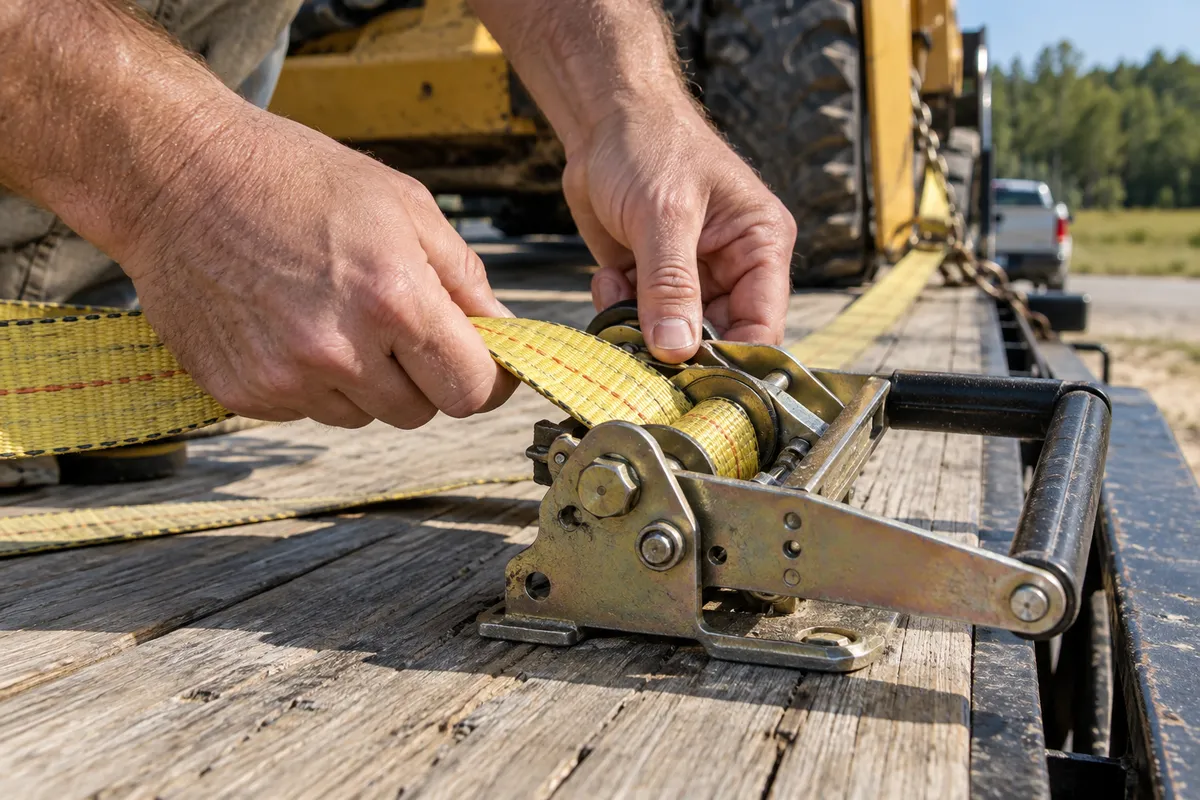
Open the ratchet fully, past 90 degrees, so it lies flat. That releases the spool and lets it turn freely.
Feed the loose webbing through the slot in the center of the spool. Feed it from underneath, so the strap comes up through the slot and lays over the top.
Pull the slack through by hand until the strap is snug. Do this before you start cranking. The ratchet is for tensioning, not for taking up three feet of slack.
Then work the handle up and down. The webbing wraps around the spool and tightens.
Two or three wraps around the spool is the target. One wrap can slip. More than four and the webbing binds against itself, jams the ratchet, and becomes very hard to release later.
Close the handle fully until it clicks into the locked position. If it does not close flat, you have too much webbing on the spool.
Do not overtighten
Snug and firm, not maximum effort.
You want the load’s suspension or tires to compress slightly. You do not need to hang your body weight off the handle.
Overtightening can crush what you are hauling, bend a tie-down point, damage the webbing at the edges, and make the strap nearly impossible to release.
Use four straps, angled out
Two straps hold a load down. Four hold it in place.
Run one from each corner, angled outward and downward. Front straps pull forward and out, rear straps pull backward and out. That pattern resists sliding forward under braking, which is where most loads shift.
Aim for roughly 45 degrees. Nearly vertical presses down but does not stop sliding. Nearly flat pulls sideways but does not press down.
Know your working load limit
Every strap has a tag with two numbers, and people confuse them constantly.
Breaking strength is where it fails. Ignore it.
Working load limit, or WLL, is the most you should ever put on it. It is usually about one third of the breaking strength. This is your number.
Add up the WLL of all your straps. The total should be at least half the weight of the load. A 2,000 lb load needs straps totaling at least 1,000 lbs of WLL.
If the tag is missing or unreadable, do not trust the strap.
Protect the webbing from edges
Webbing cuts. A strap running over a sharp steel edge or a rough corner can be most of the way through before you notice.
Use a corner protector, a piece of old carpet, a folded rag, anything that keeps the strap off the edge.
For loads with lots of sharp edges and real weight, like a tractor or skid steer, use chains instead. That is what chains are for.
Where to hook
On the trailer, use the built-in D-rings, stake pockets, or rub rail. Not a fender, not a light bracket, not a ramp.
On the load, use points designed for tie-downs. On a vehicle, use frame points, not suspension arms. A strap on a suspension arm goes slack the moment the suspension settles.
Secure the tail
Every loose strap end needs to be tied off, rolled, or tucked.
A strap flapping at 60 mph frays fast. It can also slap a car next to you, which is how you get an unpleasant conversation on the shoulder.
Simple method: roll the tail up and tuck it under a tensioned section of the strap. Or tie a half hitch around the taut part.
How to release one
Pull the release lever on the ratchet, usually a small tab beside the handle, and hold it while you open the handle all the way past 90 degrees until it lies flat.
The spool now turns freely. Pull the webbing out.
If it will not release, it is almost always because too many wraps built up on the spool and jammed it. Work the handle back and forth slightly while holding the release. Do not pry at it with a screwdriver.
When to throw one away
Retire a strap if you see:
- Cuts, nicks, or frayed edges in the webbing
- Holes or worn-through spots
- Stiff, faded, chalky webbing from sun damage
- A bent, cracked, or deformed hook
- A ratchet that will not lock or click properly
- A missing or unreadable WLL tag
Straps are cheap. A load coming loose on Highway 25 is not.
Straps or chains?
Straps for smooth or painted surfaces: cars, ATVs, UTVs, mowers, furniture, boxed cargo.
Chains for heavy equipment with rough edges: tractors, skid steers, steel-framed machines.
For a mower on our utility trailer, straps are right. For a tractor on the tilt deck, use chains.
Then recheck everything after the first few miles. Loads settle, and straps that were tight in the driveway usually are not.
Serving Montevallo, Alabaster, Pelham, Calera, Helena, and the south Birmingham metro. Get in touch with questions.
