How to Properly Distribute Weight on a Trailer
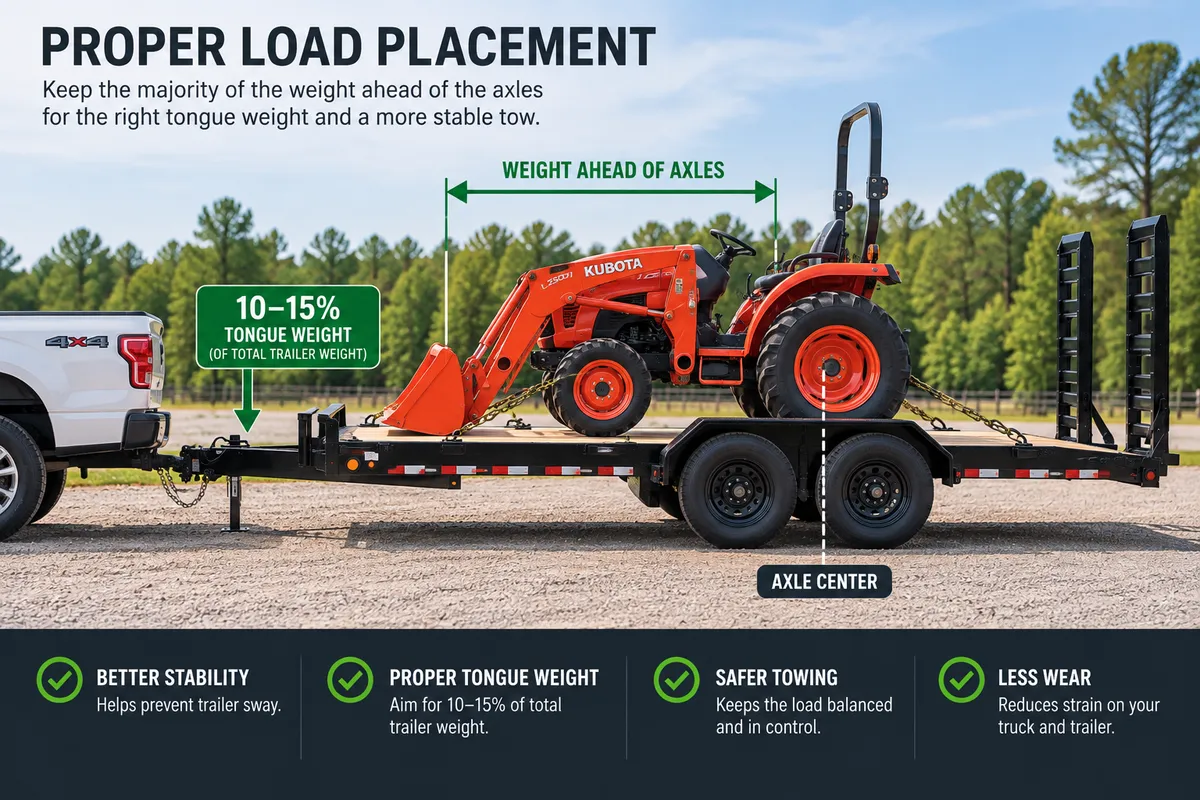
Where should the weight sit on a trailer? About 60 percent of it should be ahead of the axles. That single rule prevents most of the handling problems people run into on the road.
Here is why it works and how to actually do it.
What weight distribution controls
A trailer follows your truck because the tongue is pinned to the hitch. How much of the load sits in front of the axles decides how firmly it follows.
Load too far back and the trailer becomes a lever. Any little push from a crosswind, a passing truck, or a lane change starts a swing. That swing feeds itself and grows. That is trailer sway, and it is the most dangerous thing that happens to a bumper-pull trailer.
Load too far forward and you dump too much weight on the hitch. Your truck’s back end squats, the front end goes light, and your steering and braking both get worse.
Sixty percent forward puts you in the middle, where the trailer tracks straight and the hitch weight stays reasonable.
What tongue weight should be
Tongue weight is the downward force the trailer coupler puts on your ball.
For a bumper-pull trailer, aim for 10 to 15 percent of the total loaded trailer weight.
An 8,000 lb loaded trailer should put roughly 800 to 1,200 lbs on the hitch. Below 10 percent and you are heading toward sway. Above 15 percent and you are overloading the hitch and eating your truck’s payload.
That tongue weight counts against your payload, not your tow rating. It is a common place people accidentally go over.
How to find the axles
You cannot balance a load if you do not know where the pivot is.
On a single-axle trailer, the axle is easy to spot. On a tandem-axle trailer, the balance point is the middle, between the two axles.
Mark it. A piece of tape on the rub rail works fine. Now you can eyeball where the heavy part of your load sits relative to that line.
Positioning different loads
A tractor or skid steer. The engine is the heavy end. Point the heavy end forward and place the machine so most of its weight sits ahead of the axle line. Lower the loader bucket to the deck and drop any three-point implement. That lowers the center of gravity and reduces bounce.
A car. Drive it on nose first in most cases, since the engine is up front. Position it so the front wheels sit well ahead of the axles.
A zero-turn mower. The engine is at the back on most zero-turns. That means backing it on often gives better balance than driving it on forward. Check which way puts the heavy end forward.
Loose material like mulch or gravel. Load it centered side to side and slightly forward of the axles. Do not pile it all at the tail.
Mixed cargo. Heavy items forward and low. Light and bulky items behind them. Do not stack heavy on top of light.
Do not forget side to side
Front-to-back balance gets all the attention, but left-to-right matters too.
A load pushed to one side puts more weight on one set of tires and springs. It makes the trailer lean, wears one tire harder, and gets worse in a turn.
Center your load across the deck. If you are hauling two things of different weights, split the difference so the heavier one is not all on one side.
How to tell if you got it wrong
You do not need a scale to catch an obviously bad setup.
Look at your truck. If the rear is squatting hard and the front looks lifted, your tongue weight is too high. Redistribute rearward a little.
Look at the trailer. It should sit roughly level once hooked up. A nose-high trailer usually means the load is too far back.
Feel the first mile. A properly loaded trailer feels planted and boring. If you feel any side-to-side wander at 45 mph, pull over safely and move the load forward. Do not “see if it settles down.” It will not.
Watch it at speed. If the trailer starts to sway, do not brake hard and do not steer against it. Ease off the accelerator, keep the wheel straight, and if you have a brake controller, apply the trailer brakes only with the manual lever. That pulls the trailer straight from the back.
Then stop and fix the load before you go any further.
A note on our trailers
Our tilt deck equipment trailer is 20 feet long, which gives you real room to position a machine correctly. That length is part of why it handles compact tractors well. There is space to slide the load forward.
Our utility trailer is 10 feet, so positioning is tighter but simpler. With a short deck, small moves matter more.
The short version
Sixty percent of the weight ahead of the axles. Tongue weight at 10 to 15 percent of loaded trailer weight. Heavy end forward, centered side to side, and as low as it will go. Check how the truck sits, then check how it feels in the first mile.
If you want help planning a specific load, get in touch before pickup.
Serving Montevallo, Alabaster, Pelham, Calera, Helena, and the south Birmingham metro.
