How to Choose the Right Trailer for Your Load
How do you pick the right trailer? Answer four questions honestly and the choice usually makes itself. Skip them and you end up with too much trailer, or worse, not enough.
Here is the order we walk customers through.
Question 1: How much does it weigh?
Not “it’s probably fine.” A real number.
For equipment and vehicles, find the spec plate on the machine or look up the operating weight online. For a car, look up the curb weight.
For loose material, do the math. Dry topsoil runs about 2,000 lbs per cubic yard. Gravel is closer to 2,700. A pile that does not look like much can outweigh a small car. Wet material weighs even more.
Then add everything that rides along. Attachments, fuel, gear, and the straps and chains themselves. A load you guessed at 2,000 lbs is often 2,600 once it is sitting on the deck.
Here is the part that catches people. A trailer’s GVWR is not what it can carry. A trailer rated at 3,000 lbs GVWR that weighs 1,100 lbs empty can carry about 1,900 lbs, not 3,000. Always ask for the empty weight and subtract it.
Question 2: How does it get on the trailer?
This decides the deck type more than anything else.
You carry it or roll it on by hand. Furniture, appliances, lumber, boxes, bagged mulch. A flat utility deck with a ramp handles this.
It drives on under its own power. A tractor, mower, ATV, UTV, skid steer, or car. Now the ramp angle matters. Low machines with a long wheelbase can bottom out where the ramp meets the deck. A hydraulic tilt deck removes that bend by lowering the whole deck to one smooth slope.
Something lifts it on. Anything placed by a loader or forklift. Now deck height and open access from the side matter more than ramps.
It does not move at all. A car that will not start, or a seized machine. That needs a winch and a plan. Talk it through before you book instead of figuring it out in someone’s driveway.
Question 3: How big is it, including the awkward parts?
Measure length, width, and height on the actual object with everything attached.
Width is the one people get wrong. A tractor spec sheet lists the tread width, but the loader bucket, the mower deck, or the tires may stick out further. Measure the widest point.
Length decides where the load can sit. You need enough deck to put about 60 percent of the weight ahead of the axles. If the machine barely fits end to end, you have no room to balance it. A rear-heavy trailer sways.
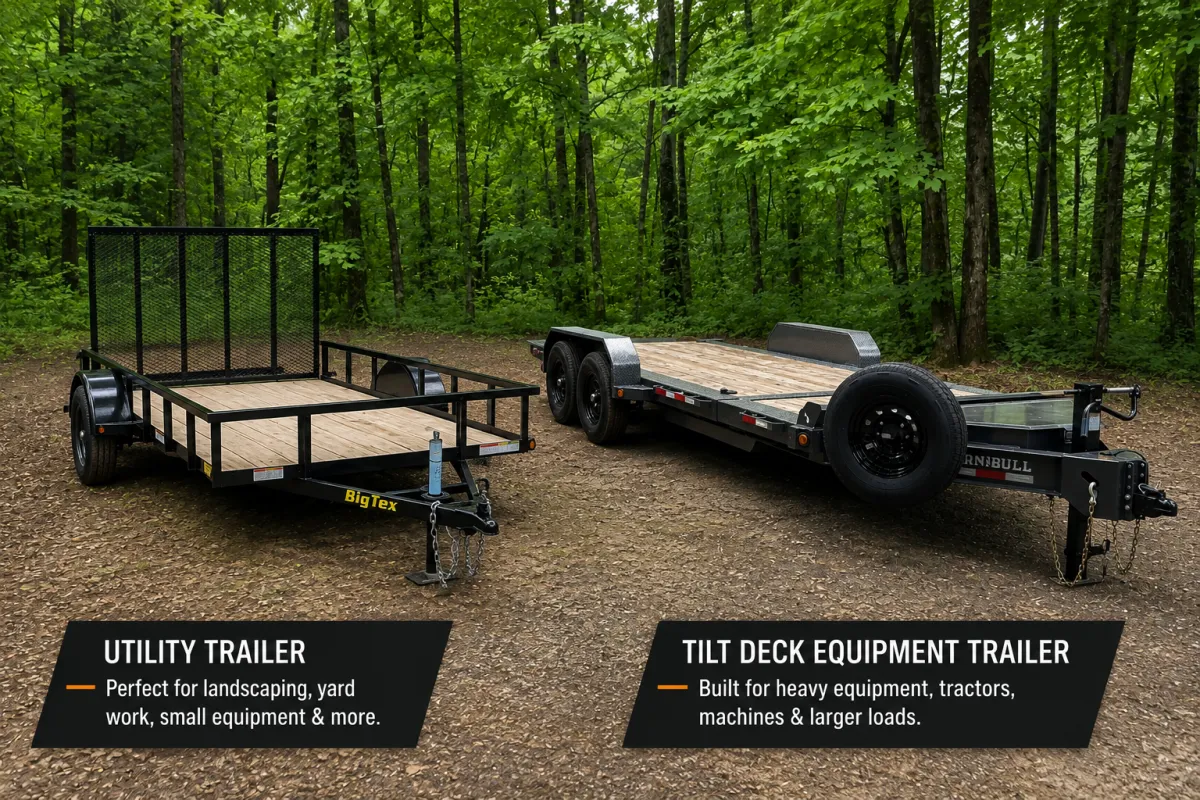
Our tilt deck equipment trailer is 20 feet by 6’ 11" and rated at 14,000 lbs GVWR. Our utility trailer is 10’ x 6’ and rated at 3,000 lbs GVWR. Between the two, most homeowner and small contractor jobs around Shelby County are covered.
Question 4: What can your truck handle?
The right trailer for the load is only right if your vehicle can pull it.
Check three numbers. Your tow rating, in the owner’s manual for your exact truck. Your payload, on the sticker in the driver’s door. And your combined weight rating.
Then check the hardware. Receiver class, ball size, plug type, and a brake controller if the trailer has electric brakes.
In Alabama, trailers at or above 3,000 lbs gross weight must have brakes that come on by themselves if the trailer breaks away. Safety chains are required and have to be crossed under the coupler.
If any of that is new to you, our post on checking whether your truck can tow explains where each number lives.
Some real examples
Weekend yard cleanup, brush and debris. Bulky but light. Utility trailer, easily.
Half a pallet of pavers. Small pile, very heavy. A full pallet of pavers can run 3,000 lbs by itself. Check the payload math before you assume the small trailer works.
A zero-turn mower and a push mower. Both roll on. A utility trailer with a ramp works, as long as the combined weight fits the payload.
A compact tractor with a loader. Long, heavy, and low. Tilt deck, and it is not a close call.
A car that will not start. Needs a winch and a deck long enough to place it right. Talk it through first.
A skid steer. Heavy and short. That sounds easy, but it packs a lot of weight into a small spot. Deck rating and placement both matter. Tilt deck.
The mistake to avoid
The most common error is not renting too small. It is guessing weight by how the load looks. Brush piles look huge and weigh almost nothing. A pallet of stone looks manageable and can blow past a small trailer’s whole payload.
The second most common error is booking the trailer before checking the truck.
Stuck between options? Tell us what you are hauling, roughly what it weighs, and what you are towing with. We will point you to the right one. If neither of ours fits, we will tell you that too.
Get in touch or read how our rentals work.
Serving Montevallo, Alabaster, Pelham, Calera, Helena, and the south Birmingham metro.
