How to Find Your Truck’s Towing Capacity
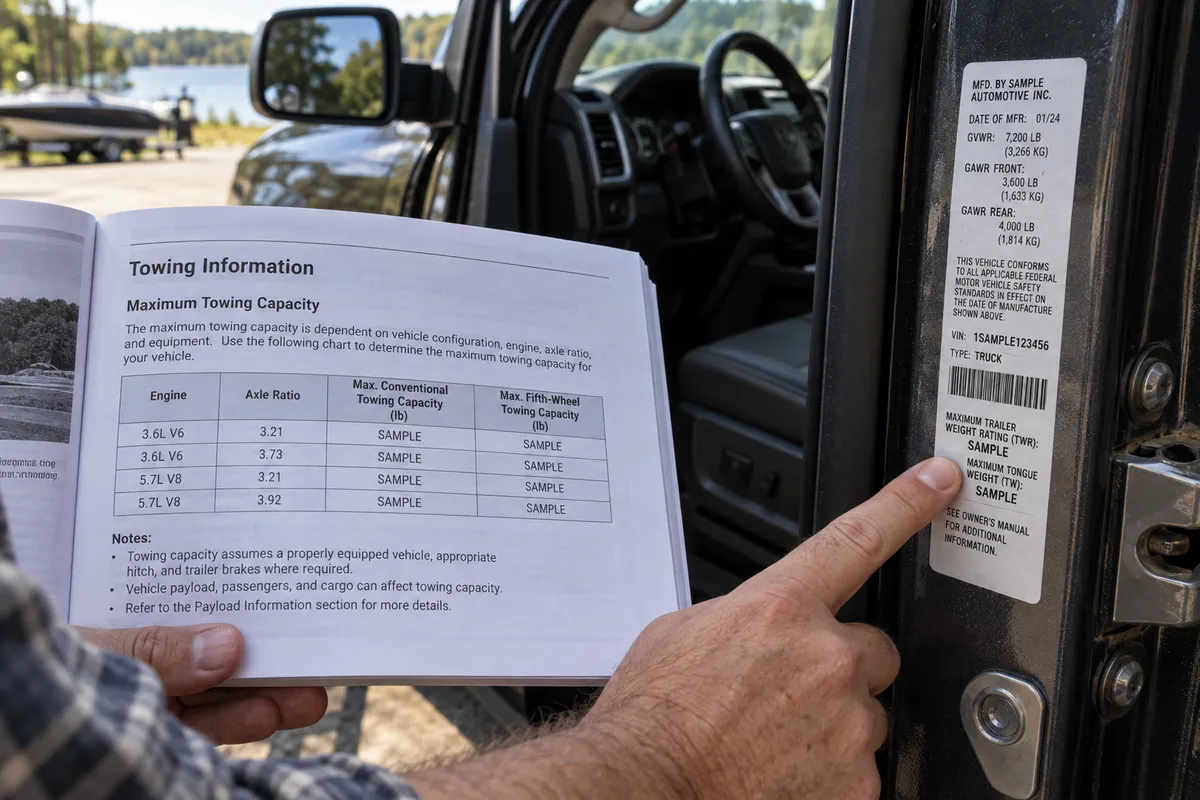
Where is your truck’s towing capacity written down? Not on the truck. It is in the owner’s manual, in a table sorted by engine, cab, bed, axle ratio, and drivetrain, and you have to find the row that matches your exact configuration.
Here is how to track it down, plus the other numbers that matter just as much.
Why the sticker does not tell you
People look at the door jamb sticker expecting a tow rating. It is not there.
The door sticker gives you GVWR and payload, both important, but towing capacity comes from the manual or the manufacturer’s towing guide.
The reason is that tow rating depends on a specific combination of options. Two trucks parked side by side, same model year, same trim, can have tow ratings thousands of pounds apart because one has a different axle ratio or a tow package.
Finding it in the manual
Open the towing section. You will find a table with rows for each configuration.
You need to know:
- Engine. Which one is actually in your truck.
- Cab style. Regular, extended, crew.
- Bed length. Short or long.
- Drivetrain. Two-wheel or four-wheel drive. 4WD usually tows slightly less because the truck itself weighs more.
- Axle ratio. This is the one people do not know.
Find the row matching all of those. Use that number, not the biggest one on the page.
Finding your axle ratio
Check the glovebox for a build sheet or option code list. Look for a code like 3.42, 3.73, or 4.10, sometimes written as GU6 or a similar code depending on the manufacturer.
Some trucks have a sticker on the differential housing under the rear of the truck.
If you cannot find it, call a dealer with your VIN. They can look up the exact build in a minute.
Higher numeric ratios generally tow more and get worse fuel economy. A 3.73 pulls more than a 3.42.
If you do not have the manual
Search the manufacturer’s towing guide for your model year. Ford, GM, Ram, and Toyota all publish these as PDFs, and they cover every configuration.
Or call any dealer’s service department with your VIN.
What not to do: take a number off a forum post or a car review. Those are for someone else’s truck.
The numbers that matter more than tow rating
Tow rating gets all the attention. It is rarely the limit you hit first.
Payload. This is on the door jamb sticker, usually worded as “the combined weight of occupants and cargo should never exceed X lbs.”
Everything you add counts: you, passengers, gear in the cab and bed, the hitch hardware, and the tongue weight pressing down on the ball.
Tongue weight is typically 10 to 15 percent of the loaded trailer weight. On a 10,000 lb trailer that is 1,000 to 1,500 lbs, straight out of payload.
A truck advertised at 11,000 lbs of towing might only have 1,500 lbs of payload. Two adults and some tools, and you are close to the line before you hook up anything.
GCWR. Gross combined weight rating caps the truck and trailer together, fully loaded. If you are near your limits, this is the honest test.
GAWR. Gross axle weight rating, per axle. You can be under GVWR overall and still overload the rear axle.
You have to satisfy all of them, not just the one you like best.
Running your own numbers
Weigh the truck as you will actually drive it, with people and gear aboard. Subtract that from GVWR. What remains is what you have left for tongue weight.
Then work backward. If you have 900 lbs of payload left and tongue weight runs 12 percent, the most trailer you can handle is about 7,500 lbs loaded, regardless of what your tow rating says.
Compare that against the trailer plus load you actually plan to haul. Our post on trailer payload capacity covers the trailer side of the math.
Tow ratings assume conditions you may not have
The published number comes from a standardized test, typically with a driver, no passengers, and no cargo.
Real life is different. Four people and a loaded bed reduce what you can actually pull.
Terrain matters too. Around Shelby County you have real grades on Highway 25 and the climbs toward Columbiana and Wilton. A truck that feels fine on flat interstate works considerably harder on those. Heat matters as well, and August in Alabama is not a mild test.
If you are within 10 or 15 percent of your rating, treat that as your practical ceiling rather than a target.
Check the hardware too
Ratings assume everything in the chain is rated for the job.
Your receiver has its own class and rating, stamped on it. Your ball mount has a rating. Your ball has a rating and a size, usually 2" for smaller utility trailers and 2-5/16" for equipment trailers.
Your wiring matters as well. A 4-pin flat plug carries lights only. Electric brakes need a 7-pin round plug and a brake controller in the cab.
Alabama requires brakes on trailers at or above 3,000 lbs gross weight, with automatic breakaway engagement, plus crossed safety chains. Our post on brake controllers explains how to tell what you have.
The five-minute version
Owner’s manual, towing table, your exact configuration. Door sticker for payload. Subtract what is already in the truck. Check your receiver, ball, and plug. Leave margin.
Or tell us your truck’s year, make, model, cab, bed, and drivetrain, plus what you want to haul, and we will tell you whether it works. Get in touch.
Serving Montevallo, Alabaster, Pelham, Calera, Helena, and the south Birmingham metro.
